The HYNES Team
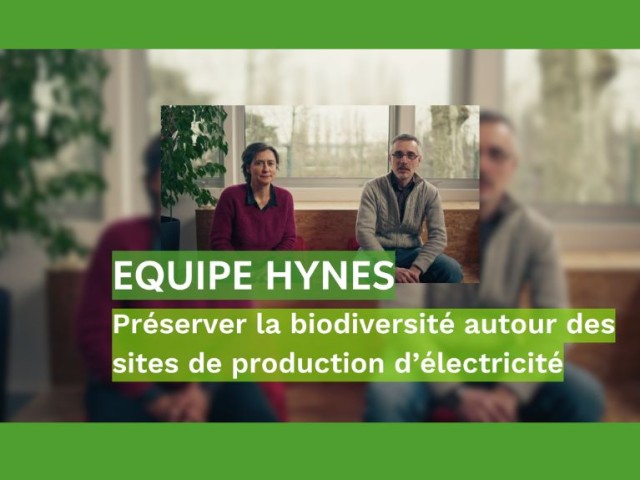
Established in 2009, HYNES is a joint research team bringing together INRAE (the French National Research Institute for Agriculture, Food and the Environment) and EDF’s R&D division. Its objective is to understand and manage the impacts of power generation facilities on aquatic ecosystems. Véronique Gouraud, Senior Researcher at EDF’s R&D division and Director of HYNES, and Hilaire Drouineau, Research Engineer at INRAE and Co-Director of HYNES, bring their expertise and passion for the environment to this team, whose challenge is to reconcile energy production with biodiversity conservation.
For 15 years, EDF’s R&D division and INRAE have been working together through the joint HYNES research team to understand and manage the interactions between electricity generation and aquatic ecosystems. This partnership brings together a multidisciplinary team of 50 researchers. “Ecology is the starting point for our work,” explains Christine Argillier, a researcher at INRAE. “Although we sometimes draw on other scientific disciplines, such as hydraulics, hydrology, thermal science, sedimentology, statistics and acoustics…”
Transcription
EDF’s R&D Division Partners with INRAE
HYNES: Preserving Biodiversity Around Power Generation Sites
Duration: 6:57
Your browser does not support javascript.
To enable you to access the information, we suggest you view the video HYNES: Preserving Biodiversity Around Power Generation Sites in a new tab.
[This video presents the partnership between EDF’s R&D division and INRAE through the joint HYNES research team, which focuses on studying the impact of hydroelectric and nuclear power plants on aquatic ecosystems. It features Véronique Gouraud (Senior Researcher at EDF’s R&D division and Director of HYNES) and Hilaire Drouineau (Research Engineer at INRAE’s AQUA Department and Co-Director of HYNES).]
Our pitch
Véronique Gouraud: HYNES is a joint research team bringing together researchers from EDF and INRAE. Its objective is to develop new knowledge and solutions to help manage the environmental impacts of EDF’s activities. More specifically, our work focuses on the impact of hydroelectric facilities and nuclear power plants on aquatic ecosystems.
Hilaire Drouineau: INRAE is a French research institute that studies how ecosystems function, particularly the impact of global change on ecosystem dynamics. This includes climate change, ecosystem pollution, habitat modification and the exploitation of natural resources.
We seek to understand how these different pressures affect population dynamics—that is, how changes in the abundance of a species influence the functioning of food webs: which species eat which others, which compete with one another, and so on.
When it comes to aquatic ecosystems, one component of global change is the impact of power generation facilities. For example, thermal discharges can alter habitats, while dam construction can hinder the free movement and migration of fish along rivers.
Véronique Gouraud: Ecosystems are subject to multiple pressures arising from various human activities. The challenge for the HYNES joint research team is to identify the measures that can be implemented at power generation facilities to mitigate their impacts in this context of multiple pressures.
Our collaboration with INRAE dates back to the 1960s. The initial research focused on the impact of hot-water discharges from thermal power plants on aquatic ecosystems. Over time, partnerships were developed around a wider range of topics.
Our achievements
Hilaire Drouineau: To review HYNES’s achievements since it was established in 2009, we can start with its contribution to training and employment. Sixteen PhD students and 13 postdoctoral researchers have worked within the team. Around six researchers at these stages of their careers are involved each year.
We can also look at scientific publications, which are extremely important in research. What I find particularly remarkable is that, despite the applied nature of our research, HYNES’s work has been recognized and published in leading academic journals around the world.
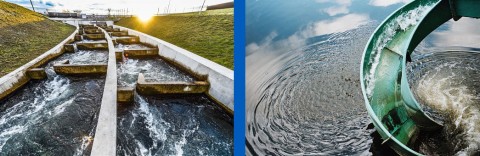
Véronique Gouraud: Our joint team works on a wide range of topics, including ensuring the free movement of fish species along rivers. The aim is to provide suitable migration conditions and enable fish to pass dams using dedicated fish passage facilities.
This is known as ensuring fish passage connectivity. We also work on environmental flows: determining the flow rates that should be released downstream of power generation facilities to maintain suitable habitat conditions.
Hilaire Drouineau: Another example is salmon migrating downstream towards the sea. By tracking tagged fish and using hydraulic modelling around dams, we have sought to better understand salmon behaviour in order to optimize downstream passage facilities, improve their positioning and sizing, and enable fish to pass with minimal impact.
I have mentioned migratory fish, but a significant part of our research also aims to optimize passage facilities for non-migratory species, an issue that is attracting increasing attention.
Our challenges
Véronique Gouraud: One of the main challenges in the HYNES joint research team is integrating different spatial and temporal scales. To explain the state of biodiversity along a stretch of river, we need to account for local factors affecting biodiversity, as well as processes operating on a much broader regional scale.
The second challenge is the diversity of impacts generated by power generation facilities, which stems from the wide variety of environments in which they are located.
Hilaire Drouineau: HYNES has always been a highly successful partnership. Interestingly, it focuses on applied research with clearly defined operational objectives, which might initially appear to be a constraint.
In practice, however, it is extremely stimulating to conduct research aimed at delivering concrete solutions that can be implemented directly in the field.
Our solutions
Véronique Gouraud: The two organizations contribute highly complementary expertise. INRAE brings in-depth ecological knowledge, the resources needed to sample aquatic environments, and extensive experience in understanding how ecosystems function as a whole.
Hilaire Drouineau: For INRAE, HYNES provides an opportunity to collaborate with EDF scientists who are genuine experts in the impact of hydroelectric facilities on aquatic ecosystems and fish populations. It also gives us access to study sites and long-term datasets that we might not otherwise be able to use.
In addition, discussions within the team generate new research questions that we might not have anticipated otherwise.
Our partnerships
Véronique Gouraud: The team’s work also enables us to respond to European calls for research proposals. We have been selected for two projects: D-HYDROFLEX and ReHydro. These projects, carried out with numerous European partners, aim to reconcile electricity generation with biodiversity conservation.
ReHydro aims to increase electricity generation and operational flexibility while reducing environmental impacts and meeting the needs of other water users, including navigation, drinking water supply and recreational activities.
Hilaire Drouineau: The good news is that our partnership agreement has just been renewed for six years. We will therefore be able to continue working together on these exciting challenges until 2030.
Our future
Véronique Gouraud: In the coming years, we will broaden the team’s scientific scope and step up our efforts in two areas. The first is the impact of climate change. How can we better account for a changing climate and identify the most effective measures to address its effects?
The second area is ecological restoration. How can we implement effective restoration measures to help ecosystems recover and improve their overall health?
Cooperation with Scientific Partners
Renewed in 2019, a decade after it was established, the HYNES joint research team will continue to monitor and analyse changes in biodiversity around EDF’s power generation sites. What’s more, its scope of activities is set to expand! We put three questions to two researchers who have been involved in the programme since its inception.