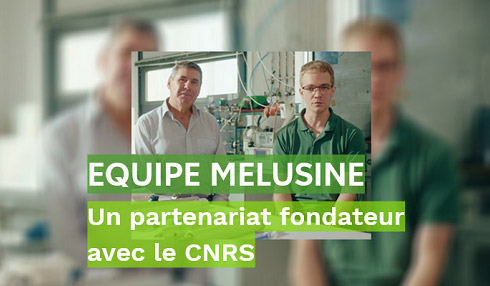
A Foundational Partnership with the CNRS
Several partnerships have been established to sustain EDF’s long-standing collaborations with France’s largest pool of researchers, the CNRS (French National Centre for Scientific Research). The joint Mélusine laboratory, for example, was established in 2018, building on previous collaborative work in process engineering, particularly on biomass and CO2 capture. The latter was the subject of Thibaut Neveux’s PhD thesis. He subsequently joined EDF’s R&D division as a research engineer and became the laboratory’s operational lead.
EDF’s R&D Division Partners with the CNRS through Mélusine to Master Processes for the Electricity Industry
Duration: 5:23
Your browser does not support javascript.
To enable you to access the information, we suggest you view the video EDF’s R&D Division Partners with the CNRS through Mélusine to Master Processes for the Electricity Industry in a new tab.
[This testimonial features Thibaut Neveux (research engineer at EDF’s R&D division and operational lead of Mélusine) and Éric Favre (Professor at the University of Lorraine, researcher at the LRGP and director of Mélusine). They explain how the Mélusine partnership, established through collaboration between EDF’s R&D division and the CNRS (University of Lorraine), explores innovative technologies to improve water treatment in power plants.]
Our pitch
Thibaut Neveux: Mélusine is a joint research team bringing together EDF and the Laboratory for Reactions and Process Engineering (LRGP) in Nancy. It is one of the many joint research teams EDF has established with the CNRS.
The partnership was launched in 2018 following extensive collaboration in process engineering, particularly in decarbonization.
Mélusine’s first research topic is effluent treatment. Power plants require large quantities of water for cooling, almost all of which is returned to the environment.
Chemicals must be added to protect the various cooling circuits. These chemicals end up in the plant’s effluents and must be removed using different treatment processes.
Éric Favre: There are three main families of water treatment technologies. The latest of these, and the one Mélusine is interested in, has been around for about 50 years. It is used, for example, to desalinate seawater and produce drinking water from it. This family of technologies relies on materials that act as molecular-scale sieves.
Mélusine’s challenge is to test, repurpose and adapt these membrane technologies, which have proven successful in other industrial sectors, to the specific requirements of water treatment in power plants.
Our achievements
Thibaut Neveux: To date, Mélusine has achieved several successes. In particular, we have built four pilot units: experimental installations large enough to assess the effectiveness of our innovations.
Our innovations can deliver energy efficiency improvements of around a factor of ten. This is a remarkable achievement when moving from conventional distillation technology to membrane-based processes.
We have also achieved improvements in compactness, system size, ease of operation and cost. Our next step, starting in 2024, is to test these pilot units under real operating conditions at a nuclear power plant. This will be the decisive test to verify that the technology works in practice.
Éric Favre: We can measure Mélusine’s success using two indicators: two international patent applications filed and three PhD theses completed. But beyond these figures, what makes this partnership exceptional, in my view, is that in just five years we have progressed from laboratory-scale testing to testing innovative technologies in an industrial environment.
Our challenges
Éric Favre: From my perspective, the biggest challenge is that the technologies we are studying within Mélusine are not currently used in nuclear power plants, which were designed in the 1970s and 1980s.
To test and qualify these technologies, we have to adapt them to an environment for which they were not originally designed, while working within significant operational constraints.
We have high hopes that these technologies will improve water treatment solutions at nuclear power plants. They could also offer advantages for the next generations of reactors.
Thibaut Neveux: We had to develop our own solutions by drawing on technologies that had already proved successful in other industrial sectors and adapting them to our needs. This is what we call technology transfer innovation.
Our solutions
Éric Favre: Scaling up from the molecular level to the size required for a power generation facility is necessarily a multiscale process. We move from the nanometre scale to systems covering several thousand square metres.
To achieve this, we need to develop a specific, dedicated and rigorous methodology based on combining different areas of expertise. This was the multiscale challenge we had to address within Mélusine.
Thibaut Neveux: The Mélusine programme has several levels of development. We started with relatively mature processes that had already proved successful in other industrial sectors, where we expected to achieve results fairly quickly. We also launched more exploratory and uncertain research initiatives focusing on innovation, particularly through PhD projects.
Our partnerships
Thibaut Neveux: At EDF’s R&D division, we can identify scientific challenges arising from our industrial needs and understand the issues involved, but we cannot always overcome them on our own. That is why we rely on research laboratories, which provide invaluable support, particularly through their extensive experimental capabilities. These enable us to test different solutions and select the most relevant innovations for our specific operating environments.
Éric Favre: Through the Mélusine partnership, our industrial partner requires us to take the complexity of the industrial environment into account. The information and insights shared through this partnership allow us to test and validate the relevance of the technological solutions we study in the laboratory under real industrial conditions.
Our future
Thibaut Neveux: Mélusine is a success, as we have just renewed the partnership agreement for a further five years, starting in 2023. In the short term, we will of course continue testing our innovations at a power plant under real operating conditions.
Éric Favre: Renewing the Mélusine partnership for another five years will open up tremendous opportunities for our research. Until now, we have focused on water treatment challenges and membrane technologies for water treatment.
We will now combine this work with carbon capture technologies. This puts us at the heart of the energy transition and the circular economy challenge.
Driven by the partnership, Mélusine’s scope of activities has gradually expanded. In 2018, the team began focusing on the treatment of effluents generated during energy production. “Effluents come from the liquids used to cool power plants,” explains Thibaut Neveux. “Power plants require large quantities of cooling water, as well as chemicals to ensure they operate properly, much like white vinegar is used in a kettle to prevent limescale buildup. This generates liquid or gaseous effluents, whose release into the environment is strictly regulated and has been the subject of studies showing that their impact is negligible. Treating these effluents is one way to maximize recycling and reduce discharges.”
Until then, effluent treatment relied on distillation or the addition of chemical agents or resins, all of which have the drawback of consuming energy or chemical resources. “Our idea is to test a new process: membrane separation,” explains Éric Favre, Professor at the University of Lorraine and researcher at the LRGP (CNRS Joint Research Unit). “Membranes are nanostructured materials, a kind of very fine sieve, that are revolutionizing certain industries, such as seawater desalination. They have rarely been used in power generation.”
This innovative repurposing of existing technology has proved successful for Mélusine. All four pilot projects have technically confirmed the effectiveness of the innovation. “We achieve ten times greater energy efficiency compared with conventional systems,” explains Thibaut Neveux. “We also save space and reduce costs.” The first real-world test is scheduled for 2024, a milestone eagerly anticipated by the laboratory team.
The partnership agreement was renewed for five years in 2023, with an ambitious research programme focused on process control in the electricity industry, particularly on carbon and water challenges in power generation. How can we help decarbonize energy uses? This remains a key concern, even for a producer of low-carbon electricity. How can we reduce the water footprint of power generation? These research efforts are paving the way for a future that is not so far away.
Other Areas of the Partnership with the CNRS
EDF’s R&D division’s main academic partner is the CNRS (French National Centre for Scientific Research). The two organizations operate under a framework agreement that defines the areas of collaboration and the terms governing it, including intellectual property rights. Together, EDF’s R&D division and the CNRS work across all of EDF’s activities, from energy generation and electricity transmission and distribution networks to the social sciences. Their collaboration can take the form of joint laboratories, such as Mélusine, or scientific interest groups (GIS).
“Our research topics are closely aligned with the energy transition and the goal of achieving carbon neutrality,” explains Ange Caruso, Partnerships Delegate within the Scientific Department of EDF’s R&D division.
One of the partners’ most widely used collaboration tools is the PhD thesis. Doctoral research is particularly effective in overcoming the scientific and technical barriers EDF faces in its role as an energy company.
“The CNRS is involved in more than a third of the 150 PhD theses currently underway at EDF’s R&D division,” notes Ange Caruso. “These cover new nuclear technologies, including small modular reactors (SMRs) and new materials; renewable energy, particularly material ageing and performance; hydrogen, wind power, water management, AI, cybersecurity, and much more.”
In the social sciences, for example, researchers study human factors in nuclear safety. Their work examines how nuclear power plants are organized and how quickly people respond in the event of an emergency.
The PhD projects launched today also aim to prepare for the more distant future. “One of the major research areas is quantum computing,” says Ange Caruso. “We do not yet have a quantum computer at our disposal, but one day this technology will become widespread. That is why we are launching PhD projects and working to overcome the scientific barriers. For example, how will we program quantum computers in the future? We need to be prepared.”
Misconception: Research Only Focuses on the Long Term
That’s not true! The Mélusine partnership, for example, took just five years to go from an initial idea to full-scale testing. “That’s exceptional for an academic like me!” says Éric Favre with a smile. In reality, research projects operate on different timescales, with some targeting medium-term results and others taking a longer-term approach. PhD theses, for instance, take an average of three years. Some researchers even believe that solving a complex problem can require two PhD theses…
In the meantime, researchers continue to explore new avenues. At the Mélusine laboratory, for example, they tested their idea by purchasing commercially available membrane modules originally designed for other industries. They then studied the materials to conduct their first tests and adapt the technology to new applications. This pragmatic approach is also an essential part of research!
CNRS–EDF Research Partnerships
These include several joint laboratories:
- Mélusine (Laboratory for Reactions and Process Engineering – CNRS/University of Lorraine) aims to develop effective effluent management solutions for the power plant of the future.
- 4EV Lab (Laboratory of Engineering Sciences for the Environment – CNRS/La Rochelle University) aims to improve the energy and environmental performance of buildings.
- EM2VM (Materials Physics Group – CNRS/INSA Rouen/University of Rouen Normandy) studies and models material ageing mechanisms.
- BHEE (Centre for Energy and Thermal Sciences of Lyon – CNRS/INSA Lyon/Claude Bernard University Lyon 1) focuses on high energy-efficiency buildings.
The partnership also includes joint research units (UMRs):
- IMSIA, the Institute of Mechanics and Industrial Applications (CNRS/EDF/CEA/ENSTA Paris), established in January 2015 to address industrial and societal challenges relating to mechanics and the durability of complex structures and systems in the energy, transport and defence sectors, focuses on multiphysics interactions and the durability of materials and structures.
- IPVF, the Île-de-France Photovoltaic Institute (CNRS/École Polytechnique/Chimie ParisTech/EDF/Air Liquide/Total SA/IPVF), established in June 2018, aims to develop breakthrough photovoltaic technologies so that solar power can make an even greater contribution to the energy transition alongside other low-carbon energy sources. This unique model brings together researchers from both public and private research organizations, including EDF, Total, Air Liquide, Riber, Horiba, the CNRS and École Polytechnique, around a shared roadmap.
Finally, the partnership includes a scientific interest group (GIS):
- The Seism Institute, inaugurated in 2012, is a scientific interest group established by the CEA, EDF, CentraleSupélec, ENS Paris-Saclay and the CNRS.