

Net zero emissions by 2050
EDF group is the world's leading producer of decarbonised electricity, i.e. produced without direct CO₂ emissions (1). As a leader in the decarbonisation of the economy, and in line with its Raison d’être to build a net zero energy future, the EDF group has set itself the goal of achieving "Zero net emissions" across all its activities by 2050. This commitment covers greenhouse gas emissions across scopes 1, 2 and 3 and all geographic regions. To mobilize accordingly, the Group is implementing a climate transition plan, supported at the highest levels of governance of the Group. This long-term ambition is supported by short- and medium-term reduction targets that are established and reviewed regularly. They are reflected in emission trajectories for all the Group's businesses and entities.
| 2027 | 2030 | 2035 |
by 2050 |
|
|
Scope 1 (compared to 2017) 51,3 MtCO₂e in 2017 |
-65 % 18 MtCO₂e |
-70 % 15.5 MtCO₂e |
-80 % 10.5 MtCO₂e |
|
| Carbon intensity of electricity and heat production (gCO₂/kWh) | 30 g | 22 g | ||
|
Total scope 3 and scope 3 – gas sales (compared to 2019) |
-30 % 83.6 MtCO₂e |
-35 % 77.6 MtCO₂e |
-45 % 65.7 MtCO₂e |
In 2020, the Science Based Targets Initiative SBTi (2) approved the EDF Group’s CO₂ emissions reduction pathway for 2030 as being "Well Below 2°C".
In 2024, Moody's validated EDF group's emission reduction targets were validated as being in line with a + 1.5°C global warming scenario. (consult the score)
In 2024, MSCI issued an assessment of 1.3°C implied temperature rise to EDF for the scope of EDF Ltd. An Implied Temperature Rise of below 1.5°C indicates that Électricité de France is in line with the Paris agreement's maximal goal of keeping global mean temperature to 1.5°C (3).
In 2024, TPI has validated EDF's emissions trajectory in line with the + 1.5°C global warming scenario for 2035 (consult the score).
2025 marks the 10th anniversary of the Paris Agreement, which motivated the development of ambitious climate policies in Europe and around the world. EDF group can boast of having divided its direct scope 1 emissions by 4 since 2015 (from 60.4 MtCO₂e in 2015 to 15 MtCO₂e in 2025) and by 3 its carbon intensity (from 95 gCO₂/kWh in 2015 to 26.5 gCO₂/kWh in 2025), while maintaining its title as the largest producer of decarbonised electricity in the world, i.e. produced without direct CO₂ emissions.
In 2025, EDF achieved a score of 73 out of 100 according to the Climate Contribution Framework (CCF) assessment, which measures companies’ overall contribution to achieving net-zero emissions. (More information about the CCF evaluation)
(1) Source ENERDATA 2025 [PDF, 477 kb].
(2) Science Based Targets is a joint initiative from CDP, UN Global Compact, World Resources Institute et World Wild Fund launched following the Paris Agreement in 2015- Read the Press release about 2020 commitments.
(3) Reproduced by permission of MSCI ESG Research LLC ©2024. All rights reserved. No further reproduction or dissemination is permitted. See the Notice and Disclaimer for Reporting Licenses.
Group carbon intensity
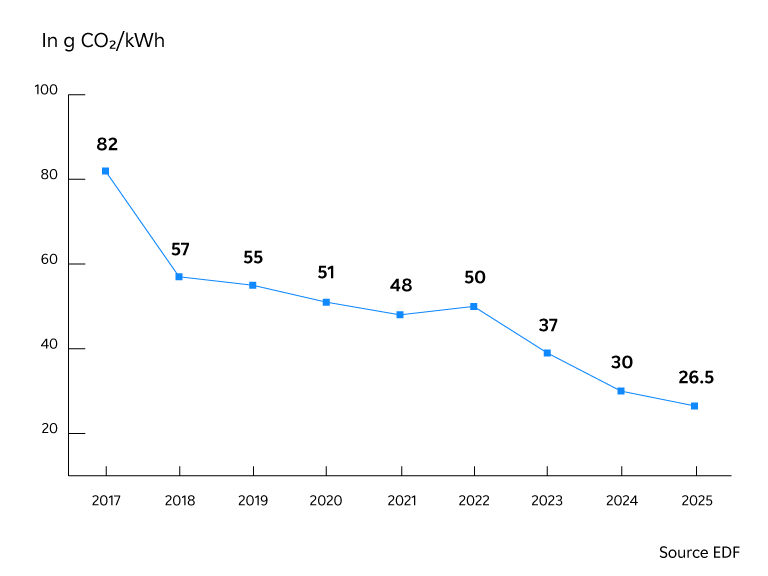
The carbon intensity of the Group's electricity and heat production amounts to 26.5 gCO₂/kWh* in 2025. This is one of the lowest-carbon productions among all electricity companies, approximately seven times lower than the European average (187 gCO₂/kWh) (1) and more than fifteen times lower than the world average (446 gCO₂/kWh) (2).
Group carbon intensity
in g CO₂/kWh
2017 : 82
2018 : 57
2019 : 55
2020 : 51
2021 : 48
2022 : 50
2023 : 37
2024 : 30
2025 : 26.5
Carbon intensity of EDF SA’s production in mainland France
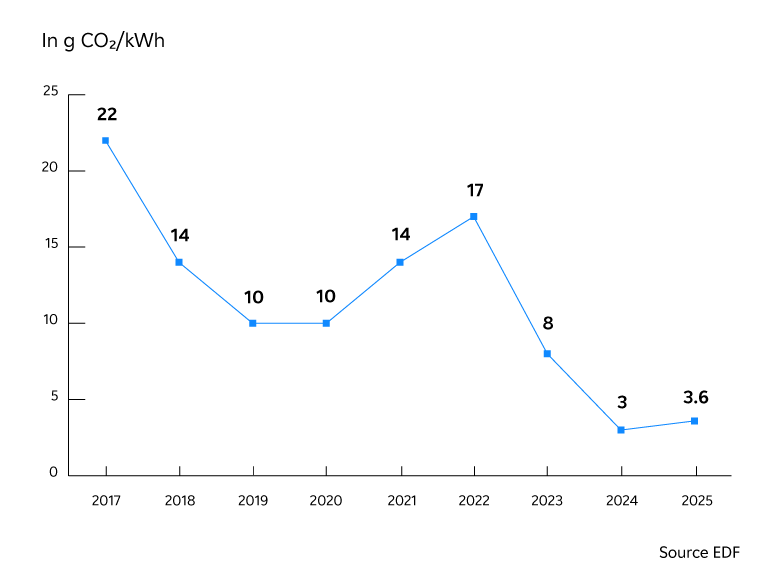
In mainland France, thanks to a generation mix that is largely carbon-free, the carbon intensity of EDF’s electricity production is only 3.6 gCO₂/kWh* in 2025.
Note: A slight increase in carbon intensity was observed in 2021 and 2022 due to a stress corrosion cracking incident that led to a decrease in EDF’s nuclear production during those two years.
Carbon intensity of EDF SA’s production in mainland France
in g CO₂/kWh
2017 : 22
2018 : 14
2019 : 10
2020 : 10
2021 : 14
2022 : 17
2023 : 8
2024 : 3
2025 : 3.6
* Direct emissions, excluding life cycle analysis of generating plant and fuel.
(1) UE 27 value in 2024, European Environment Agency.
(2) 2024 value, AIE – World Energy Outlook 2025.
A concerted industrial policy that has paid off
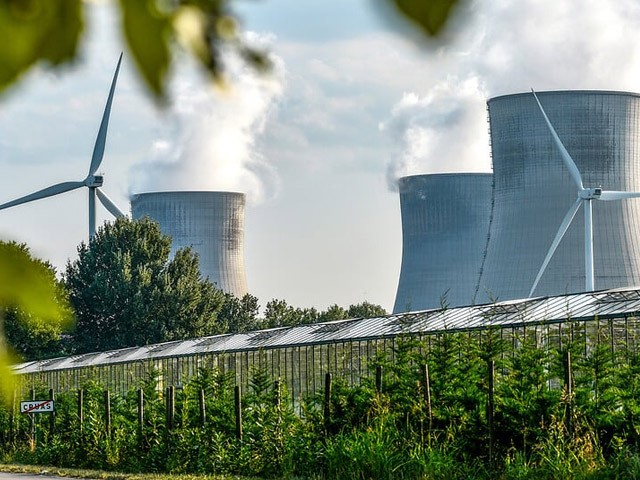
To produce low-carbon electricity, the EDF group relies on a production mix mainly composed of nuclear, hydropower, variable renewable energies (wind, solar) and gas.
Transcript
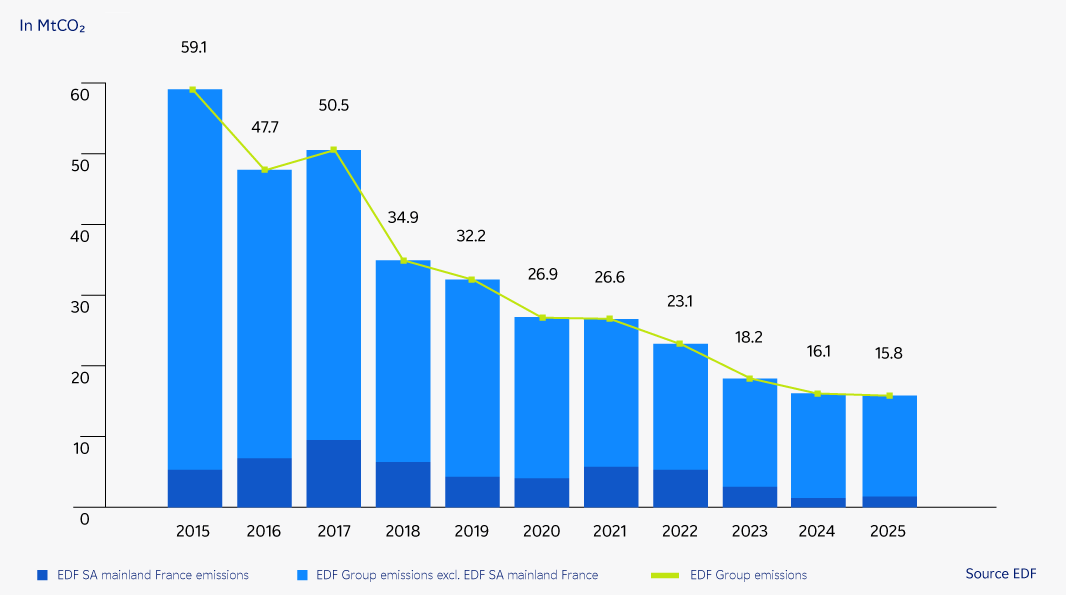
EDF group direct emissions beetween 2015 and 2025
in MtCO₂
| EDF SA mainland France |
EDF Group excl. EDF SA mainland France |
EDF Group | |
| 2015 | 5.3 | 53.8 | 59.1 |
| 2016 | 6.9 | 40.8 | 47.7 |
| 2017 | 9.5 | 41.0 | 50.5 |
| 2018 | 6.4 | 28.5 | 34.9 |
| 2019 | 4.3 | 27.9 | 22.8 |
| 2020 | 4.1 | 22.8 | 26.9 |
| 2021 | 5.7 | 20.9 | 26.6 |
| 2022 | 5.3 | 17.8 | 23.1 |
| 2023 | 2.9 | 15.3 | 18.2 |
| 2024 | 1.3 | 14.8 | 16.1 |
| 2025 | 1.5 | 14.3 | 15.8 |
The EDF group is one of the European utilities that has most actively contributed to phasing out coal-fired electricity production. Indeed, since the early 2000s, the EDF group has implemented and supported the closure of 33 coal-fired units and 15 heavy fuel oil units, representing nearly 18,000 MW of thermal capacity in France and the United Kingdom.
In 2026, the EDF group will operate only two coal units in Europe, both located at the Cordemais thermal power plant (Loire-Atlantique). The final shutdown of the Cordemais thermal power plant is scheduled for March, 31 2027.
To go further
(1) A green bond is a bond where the proceeds are used exclusively to finance projects that benefit the environment (low-carbon energy and networks, energy efficiency, etc.), with a dedicated reporting framework. EDF issued its first green bond in 2013 and has since built one of the world’s largest corporate green bond programmes.