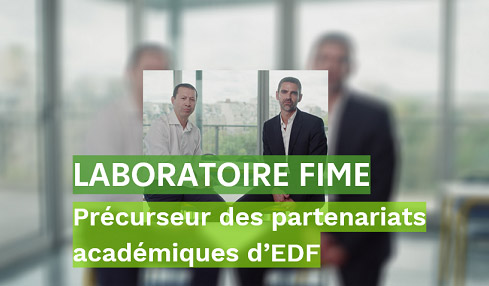
A pioneer in EDF’s academic partnerships
The FiME Laboratory, established in 2006, is a joint research initiative between Université Paris Dauphine-PSL and EDF Group’s R&D division, also involving the Centre for Research in Economics and Statistics (CREST) and École Polytechnique. Its objective? To help EDF make decisions in the face of market challenges through quantitative approaches and mathematical modelling, and to study regulatory mechanisms, seeking the right balance between market efficiency, producer viability, consumer protection and the achievement of decarbonisation targets… all in compliance with EU rules.
Among the key skills that are important yet difficult for EDF Group to find, expertise in applying mathematics to finance and economics ranks highly. “We are competing with banks in this field,” explains Olivier Féron, Senior Researcher at EDF R&D and Director of the Energy Markets Finance Laboratory (FiME). “One of the laboratory’s major achievements is that its creation has enabled us to recruit a large number of talented individuals, initially taken on as interns or PhD students.”
Transcription
EDF R&D, a partner of Université Paris Dauphine-PSL FiME
EDF R&D, a partner of Université Paris Dauphine-PSL FiME
Duration: 5:43
Your browser does not support javascript.
To enable you to access the information, we suggest you view the video EDF R&D, a partner of Université Paris Dauphine-PSL FiME in a new tab.
Two by Two
Our pitch
Olivier Féron, Senior Researcher at EDF R&D and Director of the FiME Laboratory: The objectives of this partnership are to understand how energy markets work, model them, and forecast and manage energy price risks. We develop quantitative mathematical tools to address the challenges faced by energy companies and electricity suppliers. These tools make it possible to manage risks optimally, develop innovative contracts for consumers, and help producers make investment decisions.
René Aïd, Professor of Economics at Université Paris Dauphine-PSL and member of the FiME Laboratory: The challenges faced by energy market professionals are complex. Whether you are an electricity producer, a trader or a retail electricity supplier, your decisions involve a large number of uncertain factors and decision variables. Our job is to develop decision-making models that strike the best possible balance between simplicity and realism, providing market participants with reliable results within timeframes compatible with their business activities and processes.
Our track record
R. A.: Over 17 years, we have published several hundred papers, but we have also filed patents based on the mathematical methods we developed to control electricity consumption. These methods are now part of the toolkit used by industry professionals to manage and assess risks in energy markets. I am very proud of these achievements.
O. F.: Beyond these tools, EDF needs a particular skill set that is very difficult to find when recruiting: financial mathematics. In this field, we compete with banks to attract talented candidates. The FiME Laboratory has enabled EDF R&D to recruit a great many students. One figure speaks for itself: around 20% of the PhD students and postdoctoral researchers who have worked at the laboratory have gone on to join EDF R&D. This is another source of great pride and a major success for this partnership.
Our challenges
O. F.: Quantitative mathematical approaches differ from conventional methods in certain applications. It was a risk to take, but we believed in these approaches and succeeded in demonstrating their real added value.
R. A.: I believe the main challenge in this partnership is translating the concerns of industry professionals and our partners into mathematical models, and convincing them that these models and the answers they provide genuinely address their needs. But I think the real challenge is to establish a virtuous circle in which mathematical modelling helps us tackle problems and progressively refine both the questions and the answers.
Our solutions
R. A.: Université Paris Dauphine has the key expertise needed for this partnership: understanding energy markets and modelling the behaviour of the players in these markets. It is a management sciences university with expertise in economics, finance and applied mathematics, particularly optimisation and stochastic control. These fields of applied mathematics have earned it a remarkable distinction: a Fields Medal.
O. F.: One of the laboratory's major achievements is its multidisciplinary approach. Today, it brings together economists, mathematicians, statisticians and game theorists, all of whom are able to communicate and understand one another. We are now looking to bring climatologists, sociologists and political scientists on board to address today's challenges.
Our partners' contributions
O. F.: As for each party's contribution, academic researchers generally bring their expertise and knowledge of the latest scientific developments, although EDF also has its own expertise and scientific monitoring capabilities. We bring our business challenges and data to the table. Training is another key aspect of the collaboration and one of the partnership's objectives. Academic researchers come to EDF to train its engineers, while EDF engineers contribute to student education by teaching on master's programmes and co-supervising PhD students and postdoctoral researchers.
R. A.: I am delighted to work with research engineers who bring me new and challenging problems with significant societal and economic implications. Furthermore, thanks to its long-standing nature and the long-term commitment it represents, this structure gives academic researchers the assurance that they can devote themselves fully to tackling complex problems.
Our future
R. A.: There are many aspects to the future of this partnership and the FiME Laboratory, but one is particularly close to my heart: bringing young research engineers and early-career academics into the partnership. These young professionals bring a fresh perspective to the challenges of the ecological and energy transitions. They also have a strong interest in and enthusiasm for mathematical modelling. It is important for us to involve this younger generation, because they are the future of the laboratory.
O. F.: As for the laboratory's research topics, its Finance and Sustainable Development Chair naturally addresses many of today's key issues. However, the partnership has also shown its ability to adapt and evolve its areas of activity. One example is green finance, a particularly topical issue today. This has naturally become one of the laboratory's research areas.
“Since electricity markets were opened up to competition, energy markets have involved a multitude of players, a large number of uncertainty factors, and a wide range of support and regulatory mechanisms,” explains René Aïd, Professor of Economics at Université Paris Dauphine-PSL. Nevertheless, the laboratory has succeeded in modelling these complex systems and developing mathematical and quantitative tools capable of incorporating the operational constraints faced by energy companies and electricity suppliers.
The collaboration between academia and industry has therefore been a real success. “For 17 years, we have been meeting every fortnight at the Institut Henri Poincaré in Paris. It is one of the oldest mathematics seminars,” says Olivier Féron proudly. There are no calls for research proposals here. Research topics emerge from meetings between researchers at Université Paris Dauphine-PSL and EDF research engineers. “We bring our business challenges, and they bring their scientific expertise,” explains Olivier Féron.
Training is another form of collaboration. “We, EDF research engineers, contribute to master's programmes and supervise PhD students at the university,” says Olivier Féron. “Academic researchers, in turn, provide training for EDF engineers. This also creates opportunities for our two worlds to meet.”
Over the laboratory's 17 years of existence, hundreds of papers have been published and patents filed. “We have made significant progress in risk management,” says René Aïd, Professor of Economics at Université Paris Dauphine-PSL. “We have developed new calculation methods and tools that are useful to EDF Group's operational teams.”
The laboratory currently has 45 people: 11 academic researchers, 11 EDF R&D research engineers and 23 PhD students and postdoctoral researchers. “When the laboratory was established, we had to invent not only new risk management models but also new ways of working together,” René Aïd explains with a smile. “We brought together people who were keen to collaborate and eager to develop research projects together. Today, our appeal stems from the continued relevance of our research topics, our ability to innovate… and the fact that there are still problems to solve.”
In 2022, the FiME Laboratory and the Finance and Sustainable Development Chair were renewed for a further five-year period.
Misconception: money could be invested more effectively
Investing in research today generates savings and benefits for tomorrow.
Projects often bring together multiple partners with the aim of pooling resources. “When we set up a laboratory, for example with Thales, Safran or the CNRS, we look for scientific synergies as well as financial leverage,” explains Ange Caruso. “In other words, we also aim to share the costs.” Partnership arrangements therefore vary and are tailored to each specific need.
Although it is difficult to measure the returns generated by a partnership, some figures speak for themselves: the tools and methods developed at the FiME Laboratory are now incorporated into around ten operational tools used by EDF's business teams for market risk management, optimised nuclear fuel inventory management, optimised gas storage management and the financial valuation of flexible assets, among other applications.
Recruitment is another indicator of the partnership's success. “More than 20% of the PhD students and postdoctoral researchers who have worked at the laboratory have been recruited by EDF,” notes Olivier Féron. This is a real achievement given the intense competition in the job market.
“More than 20% of the PhD students and postdoctoral researchers who have worked at the laboratory have been recruited by EDF.” — Olivier Féron, Senior Researcher in Market Risk and Pricing at EDF R&D and Director of the Energy Markets Finance Laboratory (FiME).

More than 20% of the PhD students and postdoctoral researchers who have worked at the laboratory have been recruited by EDF.
Multidisciplinarity: another strength of partnerships
As part of this partnership, EDF R&D draws on the exceptional resources of its partner. “Université Paris Dauphine-PSL brings together key disciplines for understanding energy markets,” explains René Aïd. “It has a finance laboratory, an applied mathematics laboratory, as well as an economics laboratory that can help us better understand the challenges we face.”
“One of the laboratory’s major achievements is its multidisciplinary approach,” confirms Olivier Féron. “Today, it brings together economists, mathematicians, statisticians… and everyone is able to communicate and understand one another. Our aim is to reach a point where we can also exchange ideas with climatologists, political scientists and sociologists.” This reflects the approach already adopted within EDF R&D’s research community, which brings together researchers from all these fields.
In fact, a multidisciplinary approach is essential to address the FiME Laboratory’s research topics. “These topics are often inherently multidisciplinary, such as the energy transition,” explains Olivier Féron. “It is essential to take all aspects into account to provide relevant answers.”
“Since electricity markets were opened up to competition, energy markets have involved a multitude of players, a large number of uncertainty factors, and a wide range of support and regulatory mechanisms,” notes René Aïd, Professor of Economics at Université Paris Dauphine-PSL. Nevertheless, the laboratory has succeeded in modelling these complex systems and developing mathematical and quantitative tools capable of incorporating the operational constraints faced by energy companies and electricity suppliers.