The promise of quantum computing for EDF R&D
Between “computing” and “quantum computing,” there is just one word of difference... and yet they are worlds apart: at the scale of the building blocks of matter, the laws of physics behave in unusual ways. This “strangeness” opens up enormous possibilities for improving computing resources, an opportunity that EDF R&D is closely monitoring and actively working on.
In its activities, particularly within R&D, EDF relies on many highly complex computer models that are therefore very demanding in computing time. Examples include optimizing the management of electric vehicle charging, probabilistic nuclear safety assessments, materials simulation to study ageing, and improving machine learning techniques.
Since 2018, the vastly increased computing power promised by quantum computing has therefore been the subject of active monitoring and has led to numerous partnerships within the thriving quantum ecosystem.
The Quantum Computing and Technologies project enables EDF to identify the full range of possibilities offered by quantum computing and adapt them to its needs. It also aims to monitor the threat that quantum computing poses to cryptography: current algorithms such as RSA or elliptic curves* will not withstand the power of quantum computing!
From quantum physics to quantum computing
At the scale of the atom, the very unusual laws of “quantum physics” apply. These laws are very different from those of the “classical physics” we observe in everyday life. They have been expressed in equations by Paul Dirac and Richard Feynman (both Nobel Prize winners) and many other great physicists since the early 20th century. But it was only around thirty years ago that the idea of harnessing the quantum properties of matter to process information emerged, and only much more recently that people began to think it could actually become a reality!
BUT WHAT EXACTLY IS QUANTUM?
For computing, two quantum properties hold the promise of shattering every record for calculation speed and information transmission: superposition of states and entanglement (a deep interconnection that persists over distance, provided it is not disturbed by external conditions). So while each physical bit in a classical computer can only take the value 0 or 1, a qubit (quantum bit) takes both values “at the same time,” through superposition of states. A system of n qubits will, at any given moment, be in a superposition of 2n basis states (rather than in just one of these 2n states, as a register of n classical bits would be). It’s a difference that quickly makes your head spin: just 8 qubits are enough to encode a superposition of the 256 values of a classical byte, while 300 qubits encode as many values as there are atoms in the visible Universe!
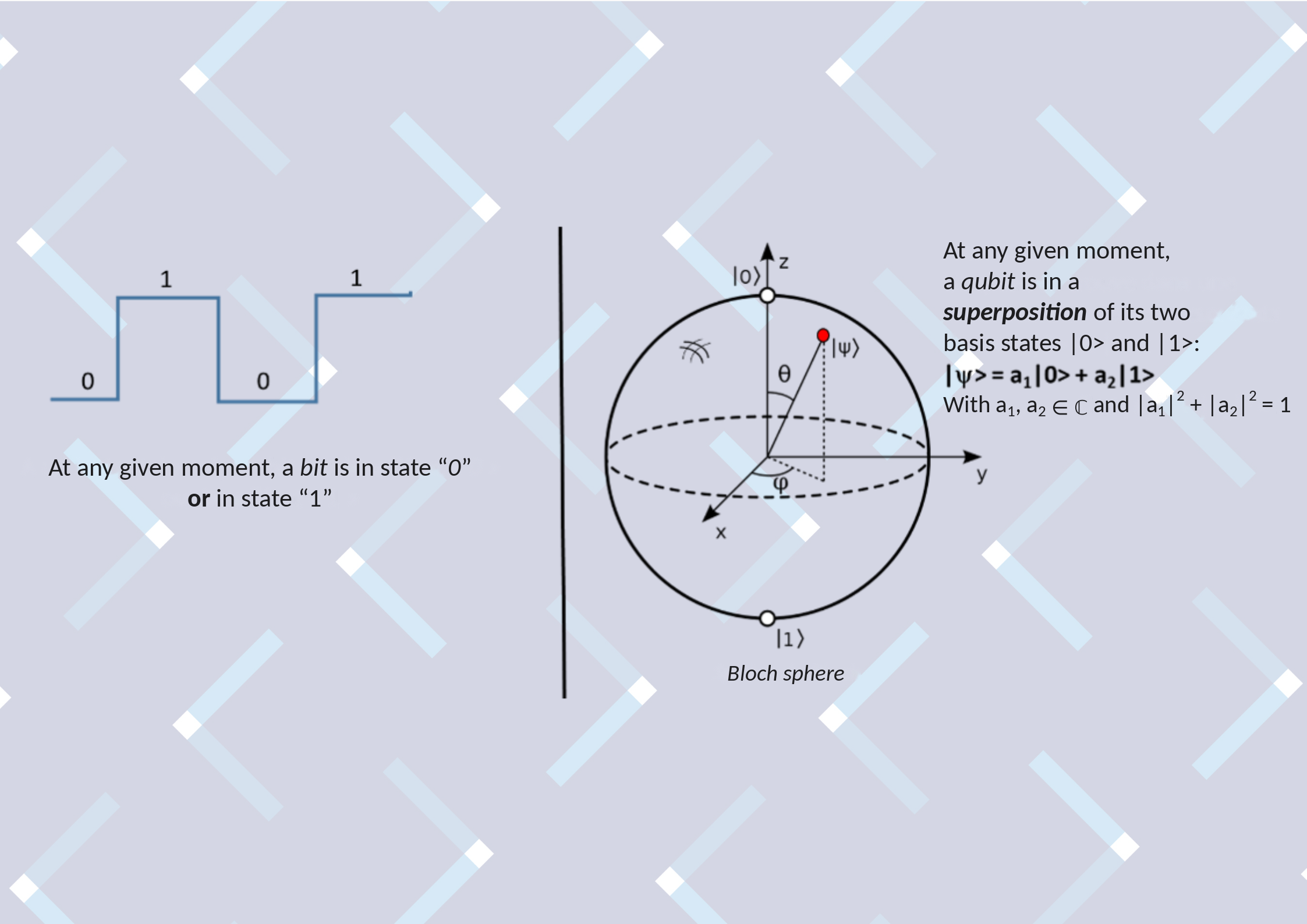
By acting on qubits through “quantum gates,” similar to the logic operators (AND, OR, NOR...) found in our computers, all quantum states can be manipulated and modified simultaneously: a “quantum parallelism” that has no equivalent in classical computing... and that makes possible calculations that are out of reach for even the best supercomputers.
QUANTUM: A PROMISING FUTURE?
Many challenges remain
On paper, the possibilities of quantum computing are mind-boggling, but it still has to be put into practice! What elements should be used to create qubits? How can they be linked, isolated from external disturbances and made to perform the desired logic operations? And how can the results be read? These questions are at the heart of research in hundreds of laboratories and companies around the world, particularly in France.
For now, various approaches are being explored, based on the use of different physical objects as qubits. The main current technologies rely on superconductors, electron spins, cold atoms, trapped ions or photons, and most of them operate at very low temperatures.
All of them face very concrete implementation problems, because quantum systems are extremely sensitive to their environment. Any vibration, radiation, temperature variation… causes decoherence, which throws the system into a random state: the information is immediately and permanently lost, resulting in errors. To “run” complex algorithms on these systems, physicists are currently working to make a sufficient number of qubits coexist and to manipulate them.
To date, the best prototypes have around 50 operational qubits, but several hundred are needed to start performing interesting calculations. On top of that, the logical qubits used for computation must be supplemented by additional qubits to correct errors. This is why the current stage of quantum computing development is known by the acronym NISQ, for “Noisy Intermediate-Scale Quantum” computing.
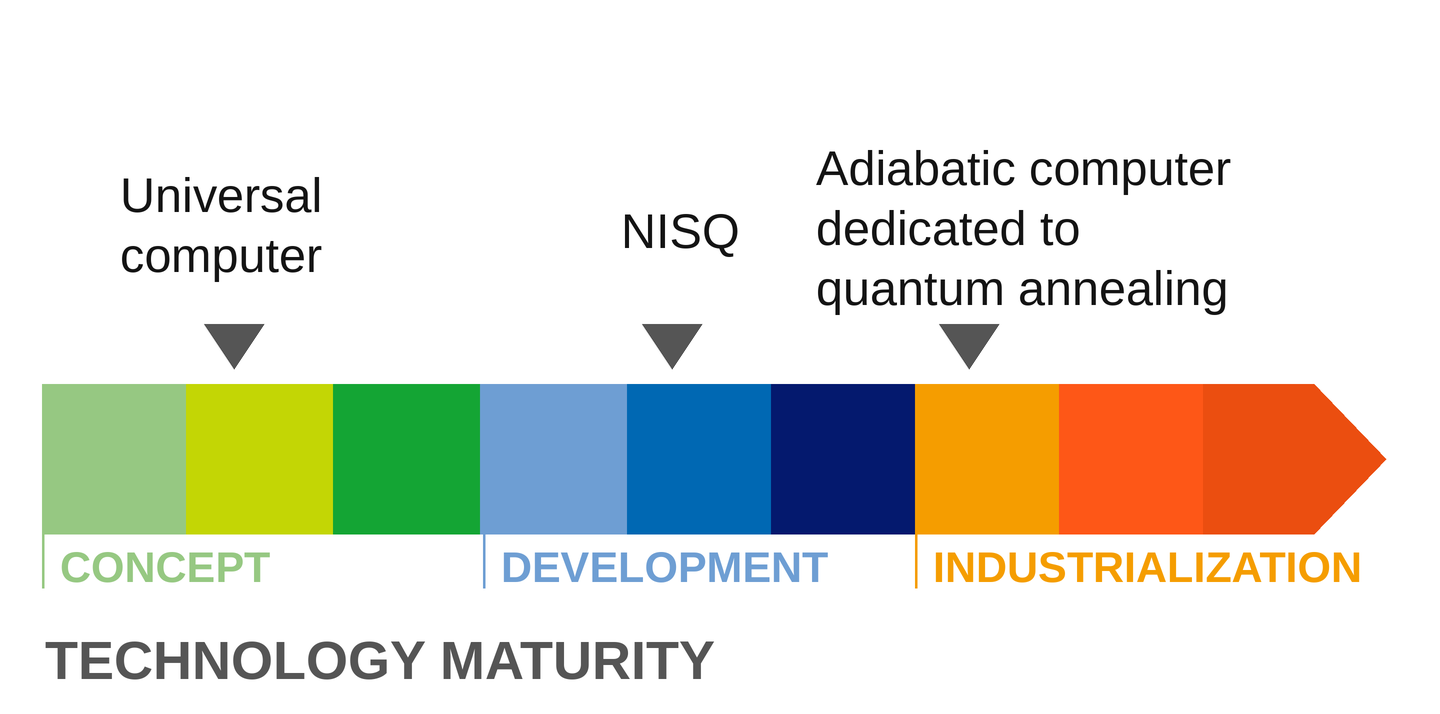
When will we be able to isolate a quantum computer from its environment long enough for it to carry out a massive calculation? No one can say for sure, but it should be a matter of a few years.
What can already be done – at the cost of complex and expensive engineering – still needs to be improved, both in terms of hardware (moving towards quantum hardware with more qubits and a longer “coherence time”) and software (developing quantum software with shorter quantum gate execution times). It will then be possible to run programs that are less and less disrupted by the noise generated by the computer’s environment.
Nevertheless, to start programming quantum algorithms – which are fundamentally different from their classical counterparts – “quantum simulators” already exist that make it possible to carry out initial tests. Beyond quantum hardware and software, the goal is to “take ownership” of their possibilities for business applications: this is what EDF R&D is doing.
* RSA and elliptic curve encryption are cryptographic algorithms widely used to exchange confidential data over the Internet.