


Managing energy and optimizing: Smart charging
The number of electric vehicles is constantly increasing... and the number of charging stations must therefore keep pace. How can their availability and electricity demand be managed across thousands of stations, for millions of vehicles, with a view to “smart charging”? Quantum computing could make this easier to manage.
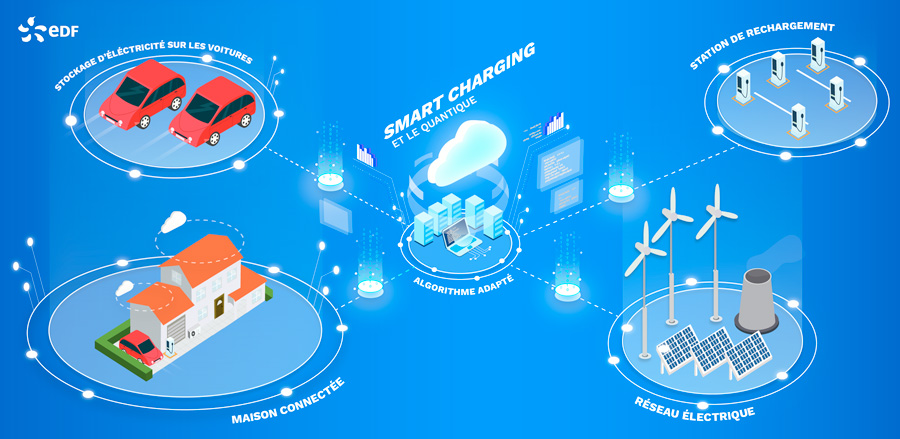
Managing future electricity demand at charging stations is far more complex than offering a “full tank” of fuel, which is easy to store. Each electric charging point, within a network covering an entire territory, will need to be able to supply the electricity requested by users, even though “filling up” takes longer and demand varies depending on the day, time or season...
For the electricity supplier, it is therefore necessary to optimize the management of vehicle charging, which is closely linked to the planning of electricity supply (and its generation). This is achieved through smart charging, an approach based on modeling all the stations and the demand at each one, in order to best size the electricity available at any given moment. As an integral part of the Electric Mobility Plan launched by EDF in 2018, smart charging offers another benefit: electric vehicles on the road are so many “batteries on wheels,” able to store electricity when there is a surplus and “give it back” when demand on the grid becomes more pressing. This is an interesting prospect at a time when generation sources are diversifying and include more intermittent sources, such as solar and wind. This aspect of smart charging, known as Vehicle-to-Grid or “V2G,” is therefore part of a much broader vision of electricity generation management.
EDF R&D is actively working on this issue with Pasqal, a company that develops quantum computers based on neutral atom technology.
EDF R&D and Pasqal
Discover how EDF R&D and Pasqal are using quantum computing to tackle the challenges of smart charging for electric vehicles.
Quantum computing for nuclear safety
To ensure the safety of its nuclear reactors, EDF must consider every possible accident scenario. This risk analysis meets both operational and regulatory requirements. For a system as complex as a reactor, the calculations are highly complex and very time-consuming. Quantum computing opens up new possibilities.
A probabilistic safety assessment (PSA) is an approach that evaluates risks by systematically exploring every scenario that could lead to a malfunction and quantifying its probability of occurrence. Complementing deterministic studies – which involve quadrupling each safety device – probabilistic nuclear safety assessments identify every possible failure in the systems that ensure a nuclear reactor operates properly.
“We identify every possible initiating event: an electronic component that ‘burns out,’ a water leak in the cooling system, an earthquake, a flood, a human error…,” explains Mohamed Hibti, senior expert researcher at EDF R&D and a specialist in the computer modeling of combinatorial problems. “Then we work out the possible combinations of equipment or human failures, and we model the actions to be taken, depending on whether the reactor is operating at full power, at reduced power or shut down.” Different families of scenarios are thus considered and broken down into “event trees,” which are built from a qualitative analysis of accident sequences.
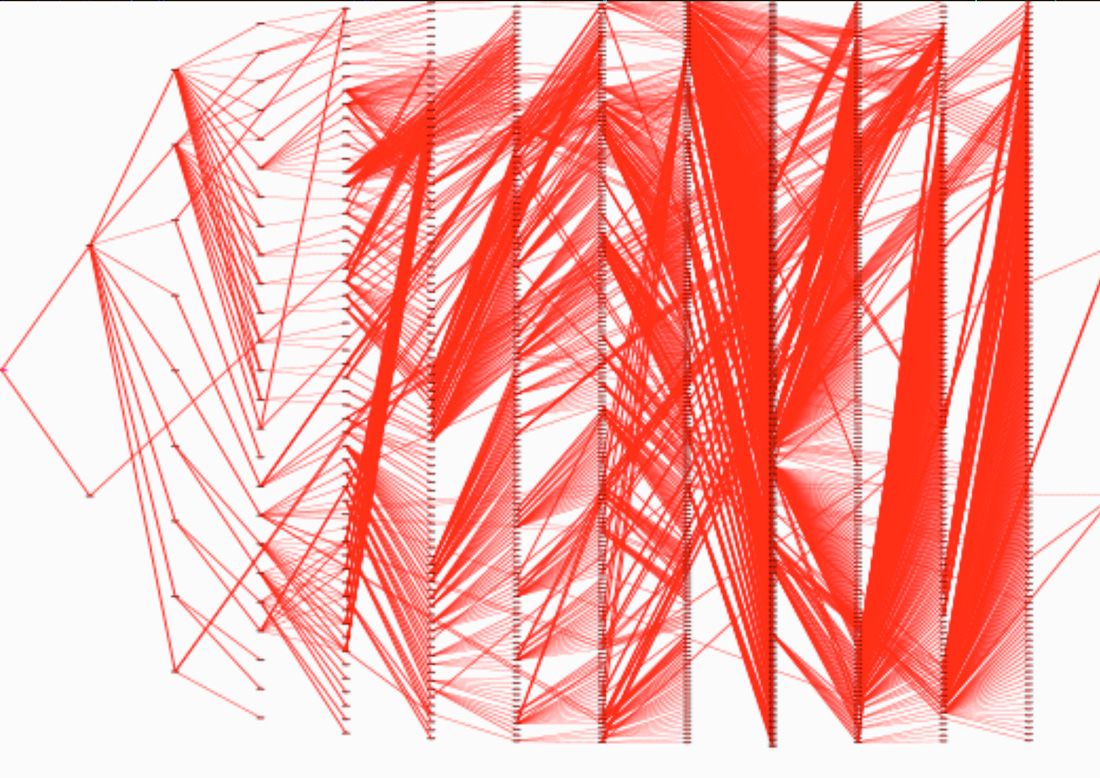
An event tree models all the scenarios that follow an initiating event.
For a reactor, PSAs are highly complex, because the number of scenarios grows exponentially with the number of possible failure sources. “We work on probabilistic models that take into account hundreds of initiating events, each of which generates up to a hundred possible scenarios,” says Mohamed Hibti.
What quantum computing brings
Currently carried out on desktop computers or servers, safety assessments make it possible to identify potential weaknesses in systems, prioritize them and put countermeasures in place in the event of an incident. Quantum computing would make it possible to “rethink” them. “Calculations would be faster to run and would also provide a dynamic view, taking into account both the order in which events occur and the possibility of a system being brought back into service while an alternative procedure is being applied,” says Mohamed Hibti enthusiastically. EDF R&D is preparing for the quantum computing era by currently testing its first quantum algorithms on simulators and available quantum computers.
Materials simulation and quantum metrology
Materials simulation could take a leap forward with quantum computing. This will benefit EDF in areas such as monitoring generation facilities or designing photovoltaic panels and batteries. Quantum technology is also carving out a prominent place in the field of sensors, which are essential for monitoring various electricity generation units.
Materials simulation is essential for EDF, both for understanding the ageing of steels in nuclear reactors and for assessing how the performance of photovoltaic panels or the charge capacity of batteries degrades over time. However, as soon as they are carried out at the atomic level, calculations on these physical problems quickly come up against the limits of current computing resources. The accuracy of the results is therefore constrained by the limited capacity of classical computers. Quantum computing would be a game changer.
“When we run an atomic simulation to study the ageing of iron, for example, certain fine physical aspects are neglected to keep computing time reasonable, but this undermines the accuracy of the results,” explains Christophe Domain, senior research engineer in the Materials and Mechanics of Components department at EDF R&D. “The same goes for battery oxides, which have a complex electronic structure, or stainless steels, which have the particularity of being ‘paramagnetic.’ For the latter, calculations are performed on a very detailed basic model, but without taking spin* into account, because that would multiply computing time by 100. With a quantum computer, we could incorporate spin* and thus refine the calculation to obtain better descriptions.”
New, ultra-precise quantum sensors
In addition, monitoring work is being carried out on quantum metrology. This set of technologies harnesses quantum properties to improve the precision of sensors. These accurate and highly sensitive quantum sensors have already begun to emerge in atomic clocks and in nuclear magnetic resonance (NMR) applied to imaging (MRI).
“The very high sensitivity of quantum sensors makes them fragile with respect to their environment, due to the phenomenon of decoherence. But we are already seeing the emergence of potentially high-performance quantum sensors for applications that interest us, such as monitoring generation facilities or mineral exploration for underground CO2 storage. They now need to move beyond the demonstration stage and become functional instruments, including outside the laboratory.”
* In quantum physics, spin is one of the intrinsic properties of particles, like mass or electric charge. Like other quantum observables, its measurement yields discrete values and is subject to the uncertainty principle.
Improving machine learning techniques
Electricity generation includes a growing number of intermittent sources. How can all generation be matched to demand, while taking into account variations in output and essential maintenance outages? Machine learning can provide answers. The arrival of quantum computers will make it even more effective.
Machine learning (ML) techniques involve analyzing past data and then using it to “predict” future events. But these learning programs, which are now used in countless fields, require a large amount of training data to produce a reliable result, as well as calculations that can take a long time. Beyond the trade-off between computing time (cost) and reliability, the result always emerges without anyone being able to explain “how.”
Quantum computing could combine speed, reliability and explainability. For EDF, this would have many applications. One of them is the precise scheduling of its various generation assets based on detailed forecasts of uncertainties, including the level of electricity demand and renewable energy output. “It would then be possible to determine even more optimally the best times for essential maintenance outages.”
“Machine learning is a good tool for supply/demand problems, so we need to be able to simulate data. Quantum computing is ideally suited to this, because it is based on intrinsically probabilistic calculations, just as machine learning relies on a probability distribution. The arrival of quantum computing is actually very timely – even if it is only 5 or 10 years away – because the growing number of local renewable energy sources, whose output is partly self-consumed, is adding to centralized sources such as ours.”