

Renewal of the EDF x CentraleSupélec collaboration through RISEGrid
The RISEGrid institute (Research Institute for Smarter Electric Grids) is celebrating its 10th anniversary. Established in 2012 through an initiative by EDF and CentraleSupélec, the agreement between the two partners has just been renewed for a further five years.
The institute is dedicated to the study and modelling of smart electricity grids and their interactions with the entire electricity system. Its research focuses on Smart Grids through a scientific programme structured around five key areas:
- Studies of smart power systems and local grids
- Observability of the electricity system
- Information systems and communications
- Advanced modelling and simulation
- Power electronics
The scientific programme brings together a dynamic portfolio of research topics, demonstrating that the institute remains at the forefront of current developments in smart electricity systems. Over the past 10 years, 15 PhD theses have been completed, with a further 7 currently underway.
Following a morning dedicated to presentations by PhD students on their research, the renewed agreement was signed by Carmen Munoz Dormoy, Director of EDF R&D's Downstream Activities, and Romain Soubeyran, Chief Executive Officer of CentraleSupélec.
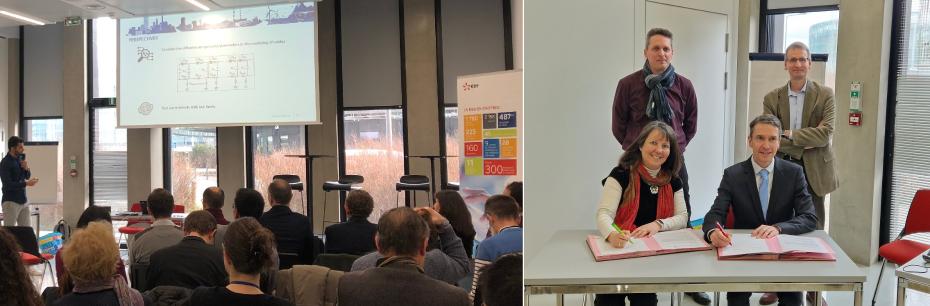
Signing of the renewed partnership during the RISEGrid Scientific Day.
L'institut RISEGrid en 8 thèses
Adaptive Sizing of Microgrids Considering Uncertainty and Network Architecture
PhD thesis conducted by Elsy EL SAYEGH
This thesis focuses on the techno-economic sizing of microgrids to ensure resilience and robustness in the face of uncertainty. How can short-, medium- and long-term uncertainties, such as increasing electricity consumption, changing costs and uncertainties in power generation, be incorporated into the optimisation process to optimise investments over the lifetime of a microgrid project?
Publication: E. EL SAYEGH, N. SADOU, P. HAESSIG, S. NASR, J. BRUSHI, B. JACQUET, A. EL AKOUM, H. GUEGUEN. Towards avoiding microgrid design failures arising from an unrealistic operating strategy: an anticipative White Box model versus a responsive Black Box model, SEEDS / JCGE 2022 Conference.
Frequency-Domain Simulation of Distribution Networks: Integration of Nonlinear Models and Convergence Methods
PhD thesis conducted by Ansaar Mohsin DADA
Electricity quality depends in particular on voltage and current harmonic disturbances. These disturbances must be taken into account when designing electrical installations and the filtering solutions to be implemented. They are primarily caused by equipment incorporating power electronic converters. This thesis focuses on developing innovative methods, techniques and algorithms to model the harmonic behaviour of equipment, taking power electronics into account as well as their dependence on their operating environment, using machine learning methods.
Publication: A. DADA, E. LABOURÉ, M. BENSETTI, X. YANG, F. COURONNÉ, M. CAUJOLLE. Enhanced Machine Learning Methods for Nonlinear Harmonic Source Modelling, CIRED 2021.
Low-Voltage Network State Estimation from Smart Meter Data Using Machine Learning Techniques
PhD thesis conducted by Elio EL SEMAAN
The development of electric vehicles (EVs), residential photovoltaic (PV) systems and self-consumption is creating new challenges for electricity networks, including overvoltages and overloads. Distribution system operators increasingly need real-time or short-term predictive insight into the operating conditions of their low-voltage (LV) networks. The deployment of smart meters provides improved visibility through an unprecedented number of remotely readable sensors. However, technical and regulatory constraints limit their use. Conventional machine learning methods appear promising but involve numerous technical limitations. The aim of this thesis is to develop a hybrid state estimator that applies machine learning techniques while respecting the system's electrical engineering equations.
Publication: E. EL SEMAAN; D. TIEN NGUYEN, A. IOVINE, T. D. LE, P. DESSANTE, K. KAMGA, D. CROTEAU. Performance Evaluation of an Autoencoder State Estimator with Realistic Low Voltage Grids Constructed from Open Data, CIRED 2023 Conference, Rome, Italy.
Control Model for Multi-Energy Systems Based on a Physical Description in Modelica
PhD thesis conducted by Joy EL FEGHALI
District heating networks incorporating heat pumps (HPs) as heat sources can provide flexibility to electricity networks. These systems are now part of smart city development. Heat pumps respond to demand-side management programmes by adjusting their electricity consumption to alleviate constraints on the electricity network while meeting users' heating requirements. Integrating thermal energy storage into the system can further increase this flexibility. This thesis proposes a model of a heat pump and thermal storage system supplying heating and domestic hot water to twelve commercial buildings. The objective is to reduce peak demand or minimise electricity consumption over a 24-hour period.
Publication: J. EL FEGHALI, G. SANDOU, H. GUEGUEN, P. HAESSIG, D. FAILLE. Energy-based Method for Simplifying Complex Multi-Energy Modelica Models. 14th International Modelica Conference, Linköping, Sweden, 2021.
Improving Fault Location Reliability by Combining Different Approaches
PhD thesis conducted by Elie SALHAB
This thesis aims to develop a fault location method that can be implemented in operational processes without incurring additional costs associated with installing equipment in the field. The method takes into account the characteristics of medium-voltage (MV) distribution networks, including radial topology, heterogeneous overhead lines and cables, and different neutral earthing arrangements. It must also be robust in the face of uncertainties, such as current and voltage measurements and line and cable impedances.
Publication: E. SALHAB, M. PETIT, T.D. LE, D. CROTEAU, Q. LEBOURG. Improved Method for Earth Fault Location in MV Distribution Networks with Compensated Neutral Grounding, CIRED 2023 Conference, Rome, Italy.
Quantifying Smart Grid Resilience
PhD thesis conducted by Youba NAIT BELAID
In recent years, electricity networks have continued to evolve through the introduction of information and communication technologies, enabling a range of new functionalities, including automated control, smart metering, demand optimisation, fault detection and real-time asset monitoring. At the same time, the electricity system is transitioning from a system with limited control and traditionally unidirectional power flows to an intelligent, meshed network with bidirectional power flows. The resulting smart grid can provide improved service to all connected loads, but at the cost of increased complexity. Network reliability and resilience are therefore being put to the test, particularly at the distribution level. This thesis proposes a modelling approach to quantify smart grid resilience while accounting for interdependencies between telecommunications and electricity networks.
Publication: Youba Nait Belaid, Yi-Ping Fang, Zhiguo Zeng, Anthony Legendre, Patrick Coudray, Anne Barros, Resilience Quantification of Smart Distribution Networks – A Bird’s Eye View Perspective, journal Energies, May 2021.
Optimising the Architecture of a Medium-Voltage Distribution Substation
PhD thesis conducted by Frédéric REYMOND-LARUINA
A wide range of applications use direct current (DC) and require one or more conversion stages. Combining these stages into a single converter that interfaces with the grid could improve efficiency and provide new functionalities for the distribution network. It could also deliver operational benefits, as DC links can offer advantages over alternating-current (AC) links. An assessment of the different possible solutions highlighted a major technological challenge: managing DC short circuits, which develop rapidly and can cause problems because existing converters have limited thermal withstand capabilities. Maintaining selective protection in the distribution network therefore requires more robust converters. This thesis proposes an alternative topology based on connecting components in parallel and controlling impedance paths.
Publication: F. REYMOND-LARUINA, M. PETIT, L. QUEVAL, D. HADBI, P. EGROT. Assessment of the AC/DC converters resilience to DC grids fault by electrothermal modelling. EPE'21 ECCE Europe, 2021, pp. 1–10, doi: 10.23919/EPE21ECCEEurope50061.2021.9570599.
Automated Power Quality Diagnosis in Industrial Installations
PhD thesis conducted by Maria VEIZAGA
The need to analyse power quality has increased over recent decades. Voltage sags are among the most frequent and most significant disturbances in industrial electricity networks. This thesis investigated the classification of voltage sag causes and their relative location with respect to the main measurement point. It also involved developing an algorithm that uses voltage and current waveforms to identify the causes of voltage sags in low-voltage industrial networks.
Publication: M. VEIZAGA, C. DELPHA, D. DIALLO, S. BERCU, L. BERTIN. Voltage Sag Source Classification using Multivariate Time Series and Soft Dynamic Time Warping. IECON 2022 – 48th Annual Conference of the IEEE Industrial Electronics Society, October 2022, Brussels, Belgium.
These research projects reflect the institute's position at the intersection of industrial applications and scientific excellence.