The Chair’s research aims to monitor the in-service ageing of facilities and to characterise materials and structures, taking into account new challenges associated with the degradation of mechanical properties caused by hydrogen. The objective is to propose guidelines that can be adopted by peers and become pre-standards for conducting and interpreting mini-specimen tests, with applications to hydrogen transport.
The MESSIAH Chair, resulting from a public-private partnership and led by the Mines Paris Materials Centre, has a budget of €1.6 million over four years.
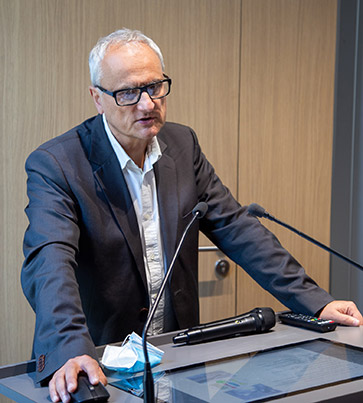
Photo of Jacques Besson of Mines Paris, Chair holder
With the support of Armines, the MESSIAH programme proposes using mini-specimens machined from coupons extracted from facilities to assess and monitor fracture toughness in service. The programme aims to develop ductile fracture mechanics testing methods that take the effects of hydrogen into account (current practice being mainly limited to brittle fracture).
The programme also plans to develop predictive simulation tools that account for scale effects, making it possible to model fracture and the effect of hydrogen on the behaviour of metals, thereby optimising the design process for facilities.
Co-funded by the ANR, it involves five leading industrial partners
Transvalor, a long-standing partner of Mines Paris in the technological maturation of its computational codes and the industrial development and commercialisation of simulation software for a wide range of applications, from materials forming to structural analysis under in-service loading conditions.
Air Liquide, a world leader in gases, technologies and services for industry and healthcare, with unique expertise in managing the entire hydrogen value chain (production, storage and distribution).
Mannesmann Precision Tubes France SAS, a member of the Salzgitter Group and a subsidiary of Mannesmann Precision Tubes GmbH, one of the world’s leading manufacturers of seamless and cold-drawn welded precision steel tubes for automotive applications, industry, fluid transportation and energy.
EDF R&D, a major player in the energy transition, operating across the entire energy value chain: generation, transmission, distribution, trading, sales and energy services.
GRTgaz, Europe’s second-largest gas transmission operator, an innovative company supporting the development of hydrogen and renewable gas sectors and exporting its expertise internationally, including services developed by its RICE research centre.

The Chair will address the following scientific challenges: scale effects in ductile fracture, interactions between hydrogen and steels, reliable fracture simulation, and coupling between mechanics and hydrogen diffusion. It will contribute to the training of four PhD students (including three under CIFRE industrial research training agreements) and one postdoctoral researcher. In addition, eight students will enrol in the specialised Master’s programme in “Materials and Structures Design” (DMS) to support the various studies. The Chair will involve engineering students from Mines Paris and, more broadly, PSL University in research activities. Finally, the Chair will enable the co-funding of additional equipment for testing in an H₂ environment, which will be installed in the laboratory.
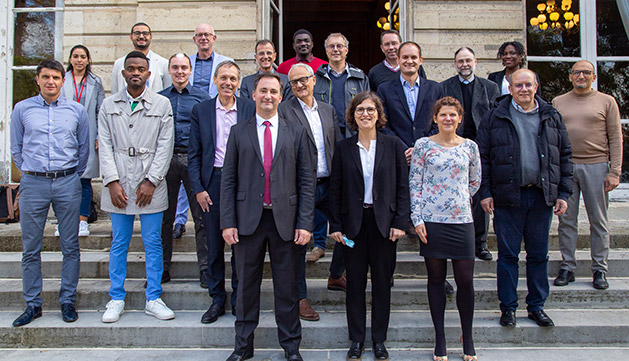
The MESSIAH Chair at a glance
Duration: 4 years (2021–2024)
Budget: €1.6 million
Funding: 50% from the ANR, 50% from industrial partners
2 Chair holders: Jacques Besson, CNRS Research Director, and Yazid Madi, Lecturer and Researcher at the Mines Paris Materials Centre
Team: 4 PhD theses (including 3 CIFRE industrial research training agreements), 1 postdoctoral researcher, 8 students in the “Materials and Structures Design” specialised Master’s programme
Hydrogen, as a low-carbon fuel, will only be able to play a role in the new energy mix once the challenges of storage and transport have been fully addressed, making both safe and cost-effective. The use of existing infrastructure is a key part of this equation. At the French National Research Agency (ANR), we are therefore delighted to see Mines Paris working alongside France’s leading industrial players in this sector. This collaboration, combined with a hybrid approach integrating experimentation and modelling, holds particular promise. I am confident that the project will deliver useful results for energy producers, transmission and distribution operators (electricity, natural gas and hydrogen alike), and that the students fortunate enough to work on it will find it easy to enter the job market. The skills they acquire are precisely those we will all need in the future.