

Building on the success of their collaboration, EDF R&D and École des Ponts ParisTech signed the renewal of their five-year framework agreement on 6 July 2023. Their key areas of interest include:
- Hydraulic infrastructure and other fixed or floating structures (environmental impact, safety, performance and durability)
- Applied mechanics (structures, solids, fluids and their interactions)
- Applied meteorology and the atmospheric environment
- Applied mathematics (optimisation, modelling, data science, probability, etc.)
- Decarbonisation (energy, mobility, buildings and social science issues)
This framework agreement also encompasses the agreements governing the Saint-Venant Hydraulics Laboratory (LHSV), which was renewed on the same occasion, and the Centre for Teaching and Research in Atmospheric Environment (CEREA), whose agreement was due for renewal at the end of the year. LHSV and CEREA are two leading research laboratories, specialising respectively in hydraulics and in the atmospheric environment and air quality.
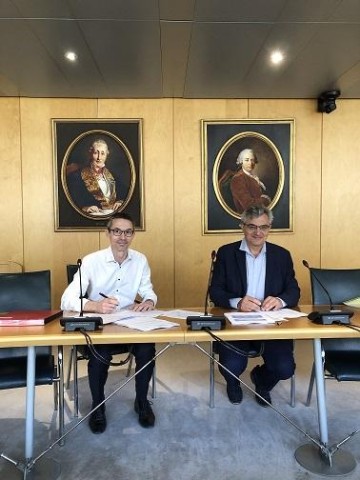
Anthony Briant, Director of École des Ponts ParisTech, and Étienne Brière, Scientific Director at EDF R&D.
Are you familiar with the Saint-Venant Hydraulics Laboratory?
The Saint-Venant Hydraulics Laboratory (LHSV) aims to play a leading role in developing numerical tools and experimental methods, as well as strengthening the expertise of researchers and engineers in hydraulics in France, with ambitions to expand its influence across Europe and internationally. Actively engaged in applied research in mechanics related to environmental hydraulics, the LHSV’s research programme for 2023–2028 focuses on two main areas:
- Hydrodynamics, primarily in natural environments
- Aquatic environments, encompassing activities such as accounting for living organisms (eco-hydraulics), modelling sediment transport, and studying changes in continental, estuarine and coastal morphology.
What is hydrodynamics?
Hydrodynamics is the study of fluid motion. In the natural environments studied at LHSV, a wide variety of flows are investigated and modelled using complex simulations:
Waves: research focuses on simulating their formation and propagation, as well as their interactions with fixed or floating structures, such as offshore wind turbines.
Flooding and inundation: whether caused by extreme weather events, such as floods, or accidental situations, such as structural failures, these sudden phenomena involve highly specific flow regimes that are particularly important to predict.
And this joint research laboratory in three key facts?
An EDF R&D scientific expert recognised by IAHR
In 2023, Damien Violeau, a senior researcher at EDF R&D and a member of LHSV since 2008, became an IAHR Fellow (International Association for Hydro-Environment Engineering and Research). This distinction recognises long-standing members of the association (at least 15 years of membership) who have made significant contributions to environmental hydraulics.
2023 Libersky Award for LHSV research
The Libersky Award is presented at each SPHERIC (SPH rEsearch and engineeRing International Community) conference by the scientific committee for the best student contribution. The award is based on both the quality of the conference paper and the quality of the oral presentation.
The award went to Pablo Merino Alonso for his research on energy conservation in the ISPH (Incompressible Smoothed Particle Hydrodynamics) method, carried out at LHSV as part of his PhD.
Following Martin Ferrand (2010), Agnès Leroy (2013, 2014), Alex Ghaïtanellis (2017) and Thomas Fonty (2018, 2019), this was LHSV’s seventh award—almost half of the 15 awards presented since 2008!
Skills sponsorship in sport and science
In 2023, LHSV researchers investigated the physics of water sports, notably through a skills sponsorship initiative between the EDF Foundation and EDF R&D. Led by Rémi Carmigniani (École des Ponts ParisTech), the research focuses on the interaction between fluid flows and swimmers. Several areas are being studied, including underwater and surface-swimming propulsion, as well as drag forces (forces that either propel swimmers forward or slow their progress).
Are you familiar with the openTELEMAC software suite, which was used, among other things, in Rémi Carmigniani’s research?
The collaboration between EDF and École des Ponts ParisTech doesn’t stop here!
At the end of the year, the two partners will also renew their collaboration through CEREA (Centre for Teaching and Research in Atmospheric Environment), a joint research laboratory established in 2003. Its research focuses on air pollution and micrometeorology in the lower atmosphere.
Want to find out more about their tools? Explore them here!
- Polyphemus for air quality modelling
- Code_Saturne for modelling the atmospheric environment at the local scale