

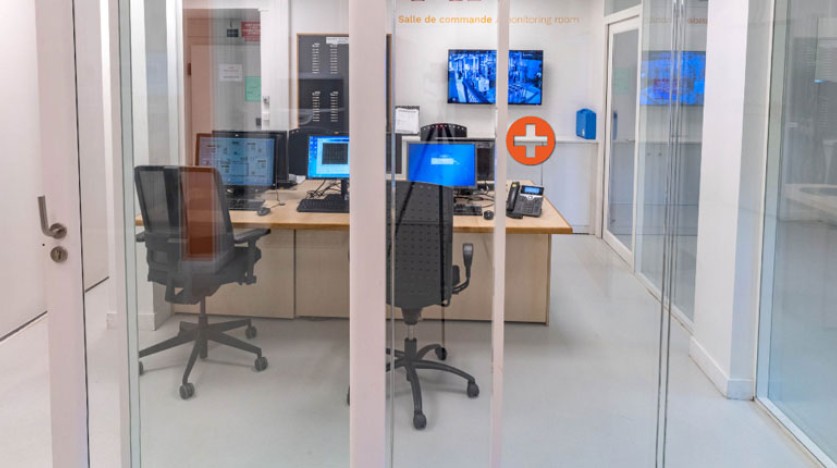
Climatron is the laboratory located at EDF Lab les Renardières, where researchers assess the performance of all types of thermal equipment (heat pumps, thermodynamic or electric water heaters, electric resistance heating systems, etc.) for residential and commercial applications under controlled climatic conditions (temperature and humidity). These tests are made possible by the platform’s 9 climatic chambers. Discover them in this video!
R&D takes you inside Climatron to test the heat pumps of tomorrow
Duration: 3:32

Your browser does not support javascript.
To enable you to access the information, we suggest you view the video R&D takes you inside Climatron to test the heat pumps of tomorrow in a new tab.
R&D takes you inside the Climatron to test tomorrow’s heat pumps.
Introduction: The Climatron is one of the oldest laboratories at the Renardières R&D site. Established in 1965, it has continuously evolved to adapt to new innovations. It is used to test heating systems and hot water production systems under different climatic conditions, by controlling variables such as temperature and humidity. This makes it possible to measure energy consumption and identify ways to reduce it and decarbonise the residential sector.
Hugues Bossche, research engineer: "The Climatron consists of a series of climatic chambers in which we can precisely control temperature and humidity. Here, we can vary the temperature from -20 to +45 degrees and humidity from 35% to 95%. We control these climatic conditions and use the chambers to test energy production systems. Today, these are mainly heat pumps and thermodynamic water heaters, that is, water heaters equipped with a heat pump. The aim is to improve heat pump performance under conditions that closely replicate real-world situations. Let us show you how it works!"
Hugues Bossche walks through the Climatron's corridors and enters a room filled with equipment. "Behind me, you can see all the equipment used to recreate different climatic conditions."
He opens a door, revealing a dedicated piece of equipment in its own room. "Here, we have the chilled water unit, which generates cooling for climate control."
Further into the laboratory, he introduces another piece of equipment. "The dehumidifier removes excess moisture from the chambers."
The camera zooms out to show a large section of the room, with numerous devices and pipes running across the ceiling. "Here, we have steam generators that inject moisture into the chambers."
Li Xiao, research engineer: "At the Climatron, we have two large climatic chambers and seven smaller ones. We are currently in one of the large chambers, where tests are often carried out on high-capacity heat pumps designed for multi-family residential buildings. Today, we have installed a thermodynamic water heater intended for this type of housing. We have recreated a humid climate at 8 degrees, and we are now ready to run a test."
The voice-over provides further details. "This test is designed to evaluate the heat pump in our thermodynamic water heater. What makes it special is that it is controlled by an artificial intelligence algorithm. This is part of a Franco-German research project involving, among others, the CEA, which is responsible for the AI component."
Li Xiao continues: "They have trained their models to understand and predict how people behave in their homes. We will use these predictions to control the thermodynamic water heater and assess its performance."
Hugues Bossche adds: "Whenever we conduct a test, we start with a baseline test. During this test, we do not control the heat pump; we
Inside the Climatron Laboratory
Duration: 2:17

Your browser does not support javascript.
To enable you to access the information, we suggest you view the video Inside the Climatron Laboratory in a new tab.
[In this report, Didier Roustan (R&D Programme Director for Retail and Services at EDF) and Florian Loyer (R&D Operations Manager at EDF) explain how EDF's R&D teams test heat pumps under real-world conditions to ensure comfort and performance.]
Didier Roustan: Over the past few months, we have seen strong growth in the residential heat pump market, although it still lags behind comparable markets in Scandinavian countries and Italy.
At EDF R&D, we believe in heat pumps. We open our laboratories to manufacturers looking to develop solutions tailored to business customers in the commercial and service sectors, as well as to private individuals.
Question: How can we combine energy efficiency with comfort?
Didier Roustan: What makes this laboratory special? Rather than measuring heat pump performance under standardised test conditions, we test them in simulated real-world conditions. Behind this door, a computer simulates the needs of a family living in their home under actual climatic conditions.
This allows us to ensure that customers can count on both energy efficiency and comfort, in summer and winter alike.
Question: What new services are you working on?
Didier Roustan: Heat pumps are now all connected. One of our key areas of work is flexibility. Thanks to hot water storage and the thermal inertia of buildings, we can shift consumption patterns to periods when demand is lower. We can programme the system to do this automatically, based on the tariff signals it receives.
Question: What else?
Florian Loyer: This connectivity also enables us to offer customers remote maintenance services. With their consent, we can remotely adjust equipment settings to improve comfort and performance. We can also detect performance issues and faults.
Question: What else can a heat pump do?
Didier Roustan: We are exploring how heat pumps can help improve indoor air quality. More and more people in France are buying air-to-air heat pumps for both cooling and heating. These systems could certainly help improve air quality, either by increasing ventilation rates or by incorporating air purifiers.
