


 Karlsruhe, Germany
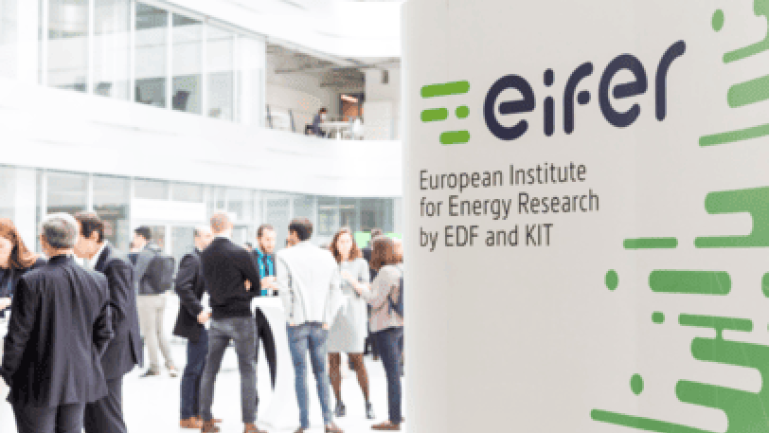
EIFER (Europäisches Institut für Energieforschung EDF-KIT EWIV) is an independent French-German energy research institute founded by EDF and KIT in 2002 to strengthen their collaboration through joint projects addressing industrial challenges.
Main research areas
- Climate-neutral territories
- Local multi-energy systems
- Low-carbon hydrogen solutions
- Energy transition, markets and the environment
Missions et activities
Duration : 2:10

Your browser does not support javascript.
To enable you to access the information, we suggest you view the video Welcome to the EIFER Research Centre in a new tab.
[This animated film presents the EIFER Research Centre, co-founded by EDF and KIT, which develops low-carbon energy solutions tailored to local needs. From hydrogen and e-fuels to local carbon neutrality, EIFER combines scientific expertise, innovation and French-German cooperation to support the energy transition.]
Welcome to the EIFER Research Centre
Founded by EDF and KIT (Karlsruhe Institute of Technology) in 2002, EIFER is an independent French-German energy research institute.
EIFER has more than 100 employees with multidisciplinary and international backgrounds.
Our missions
Design tomorrow’s low-carbon energy systems, tailored to society’s needs.
Support the transition towards reliable and sustainable energy systems.
Our activities
EIFER is a key player in the field of low-carbon hydrogen solutions, from laboratory research on components to on-site demonstrators.
EIFER develops strong collaborations with EDF and other industrial and scientific partners.
For several years, EIFER has been focusing in particular on e-fuels and alternative fuels.
EIFER helps territories achieve carbon neutrality through:
- low-CO₂ mobility plans
- territorial optimisation strategies
- spatial analysis methods
- tools for assessing environmental and societal impacts
EIFER studies the potential and limitations of carbon sequestration in natural environments in order to assess its environmental and societal benefits.
EIFER analyses and assesses trends observed in German energy markets.
EIFER works closely with other EDF Group R&D sites in France and around the world.
Focus on...
Transcription
R&D takes you... CACTUS project
The CACTUS project, “CArbon Sequestration, Soils and Natural SoluTions 2027”, is led by EIFER and aims to develop and provide the EDF Group with expertise in carbon sequestration in natural ecosystems. CACTUS aims to make recommendations on the natural solutions to be deployed by the company.

Your browser does not support javascript.
To enable you to access the information, we suggest you view the video R&D takes you... CACTUS project in a new tab.
[This report presents the CACTUS project, through which EDF R&D is exploring natural carbon sequestration solutions alongside EIFER and scientific partners. Forests, grasslands and peatlands are becoming testing grounds for enhancing CO₂ capture while preserving biodiversity and local ecosystems. It features Loraine ROY (Head of the Energy Transition, Markets and Environment Group at EIFER Germany), Léa Dieckhoff (Research Engineer and Scientific Lead for the CACTUS project) and Marie-Laure Rabot-Querci (CACTUS Project Manager, EIFER).]
R&D takes you on a journey to discover natural carbon sequestration solutions
For EDF, achieving carbon neutrality targets primarily depends on generating low-carbon electricity and electrifying end uses. But did you know that EDF R&D is also exploring natural carbon sequestration solutions, notably through the CACTUS project, led by EIFER (European Institute for Energy Research), which is investigating ways to maintain and enhance nature’s ability to capture and store CO₂?
Loraine ROY: In the CACTUS project (Carbon sequestration, soils and natural solutions), we are studying carbon sequestration in ecosystems: natural sequestration. We are looking at different environments: forests, peatlands and grasslands. These environments already store carbon, and we can increase this sequestration through the implementation of a number of management practices.
Restoring forests, for example, helps maintain this carbon stock, while also contributing to water purification, preventing soil erosion and preserving biodiversity.
We will engage with local stakeholders and address major societal challenges such as adapting to climate change.
[The team enters a building.]
Léa Dieckhoff: Since this year, we have had several pilot sites that are helping us enrich our work with field data.
[Zoom in on Léa Dieckhoff’s computer screen as she shows us an aerial map of a site.]
Léa Dieckhoff: Here, for example, we have our first site, located near the Aramon power plant, where we are converting annual crops into permanent grassland.
[EDF employees can be seen taking measurements and samples in a grassland.]
Léa Dieckhoff: At this site, we will monitor changes in soil carbon stocks, as well as biodiversity and hydrology. Hydrology is particularly important because the area will serve as a buffer zone for flooding.
[An EDF employee observes the trees using binoculars in a forest.]
Léa Dieckhoff: We are also working on forest sites, such as the one in Civaux, in the Nouvelle-Aquitaine region, on land owned by EDF.
[We return to Léa Dieckhoff’s computer screen, showing an aerial view of the forest.]
Léa Dieckhoff: Here, we are going to test a laser-based technique, terrestrial LiDAR, which allows us to measure the volume of forest biomass.
[Back in the forest, EDF employees measure the diameter of a tree trunk.]
Léa Dieckhoff: We compare the results of these measurements with a traditional method for measuring forest biomass volume, based on measurements of tree diameter and height.
One of the challenges at the pilot sites is measuring carbon. Measuring a stock at a given point in time is relatively easy. What is more difficult is measuring changes in the stock, because it evolves very slowly and we also have to account for measurement uncertainties. To address this, we work with academic partners who support us, such as INRAE in Clermont-Ferrand.
Another challenge is to never consider a single issue when designing and implementing the pilot sites. For example, carbon sequestration must not come at the expense of biodiversity.
Marie-Laure Rabot-Querci: We started from almost nothing, and it took us several years to develop this project. To build on solid scientific foundations, we assembled a multidisciplinary, curious and resourceful R&D team capable of moving between theoretical aspects on the one hand and practical implementation on the other.
Today, we are working on concrete projects with partners we have joined forces with, particularly local stakeholders and academic or scientific organisations.
Loraine Roy: EDF’s purpose drives us to take an interest in these topics and to deploy and test natural solutions that are part of the range of practices needed to build a carbon-neutral energy future.
And at EDF R&D, we are fortunate to have the opportunity to work on these future-oriented topics.
Researchers’ portraits
Transcription
Paulina NOWAK
Meet Paulina NOWAK, a researcher at the European Institute for Energy Research (EIFER) in Karlsruhe, Germany.

Your browser does not support javascript.
To enable you to access the information, we suggest you view the video Paulina NOWAK in a new tab.
Researchers from here and elsewhere takes you to meet Paulina Nowak, a researcher at the European Institute for Energy Research (EIFER) in Karlsruhe, Germany.
Paulina Nowak: I am Polish and a proud native of the beautiful city of Kraków. I am a researcher at the European Institute for Energy Research (EIFER), based in Karlsruhe, Germany.
The Axiom
Question: Professional background
Paulina Nowak: I was born and raised in Kraków, where I also attended university. My PhD focused on environmental engineering, energy and mining.
My first job after completing my PhD was as an assistant in EDF’s IT department. Then, when the opportunity arose, I moved to the R&D department. A former EDF colleague told me about an opening at EIFER in an interesting field, so I decided to apply.
The Centre
Question: The EIFER Centre
Paulina Nowak: EIFER was founded by EDF and the Karlsruhe Institute of Technology as an independent research centre to strengthen cooperation between academia and industry.
My position at EIFER is my first job abroad. Our colleagues literally come from all over the world, not just from Europe, but also from the other side of the globe, from very different countries and with very different backgrounds. They have different perspectives on what is considered normal in the energy sector and what constitutes innovation, and having the opportunity to exchange ideas about this really helps us grow as specialists.
The Equation
Question: What problem are you trying to solve?
Paulina Nowak: Let’s first briefly explain what e-fuels, or electrofuels, actually are.
They are synthetic fuels made from CO₂ captured from the air or at industrial sites, and hydrogen produced by electrolysing water using renewable electricity.
The overall process is known as “Power-to-X”.
I am currently supporting our EDF R&D team in preparing the specifications for a test platform for power-to-liquid fuels, where we would subsequently like to test different technologies currently being developed in this field.
The Median
Question: Passions, personal balance
Paulina Nowak: As a child, I joined a Polish folk dance group that performs traditional dances and songs from my country in traditional costumes and with traditional musical accompaniment, and I am still a member today.
For several months before I moved to Karlsruhe, it was my way of unwinding and letting off steam. It was great.