It is against this backdrop that EDF Pulse Ventures, the EDF Group’s corporate venture arm, has conducted a deep dive to identify the most promising solutions for maintaining balance across the electricity system.
Decentralised energy: what do we mean?
Decentralised energy refers to all solutions that enable energy to be generated, stored and managed directly at the point of consumption—whether by a household, a commercial building or an industrial site. This includes energy assets such as solar panels, storage batteries, controllable heating systems and electric vehicle charging.
Europe currently has 406 gigawatts of installed solar capacity, and 88% of small-scale installations (<1 MWp, accounting for 14% of total solar capacity)1 are owned by private individuals. For these users, the objective is straightforward: to make better use of their own energy, unlock the value of their assets, and reduce their electricity bills.
However, as intermittent renewable sources such as solar and wind expand, electricity availability fluctuates significantly throughout the day. It peaks around midday and is more limited in the morning and evening—precisely when demand is highest. To ensure security of supply, the power grid must constantly balance generation and consumption. These growing imbalances are driving a need for flexibility—namely, the ability to either activate or curtail decentralised resources within the grid.
Until recently, local electricity generation followed a largely passive model: energy was either consumed when available or fed into the grid according to fixed rules, with little regard for grid conditions, demand fluctuations or the time-based value of electricity. Producers, whether households or businesses, had limited scope to act differently. But with evolving system requirements—and thanks to connected devices, storage technologies and smart energy management—it is now possible to move from passive generation to active energy management. Each asset—solar panels, batteries, heating systems or EV charging—can be deployed at the right moment, enabling users to play an active role in balancing the power system.
1SolarPowerEurope 2025
EDF Group: already advancing the optimisation of decentralised energy
EDF Group is active across multiple segments of the decentralised energy value chain through its various entities in Europe. EDF solutions solaires supports both businesses and households with solar panel installations and has developed an intelligent self-consumption management system that automatically directs solar energy to water heaters at the point of production, improving on-site energy use. Agregio solutions helps companies and building operators optimise their energy assets. In practice, Agregio solutions aggregates and remotely controls batteries and other flexible assets to align their operation with grid needs, monetising this flexibility on electricity markets through optimisation algorithms. In the United Kingdom, EDF Energy offers solutions combining solar panels and batteries in a market where electricity prices fluctuate significantly throughout the day. In this context, generating, storing or consuming electricity at the right time becomes a key lever for maximising its value, making storage particularly relevant. In Belgium, Luminus, a Group subsidiary, has paired 40% of its new solar installations with batteries and is currently deploying a virtual power plant to aggregate these residential assets and unlock their collective value on flexibility markets.
Optimisation solutions: a strategic segment for unlocking value
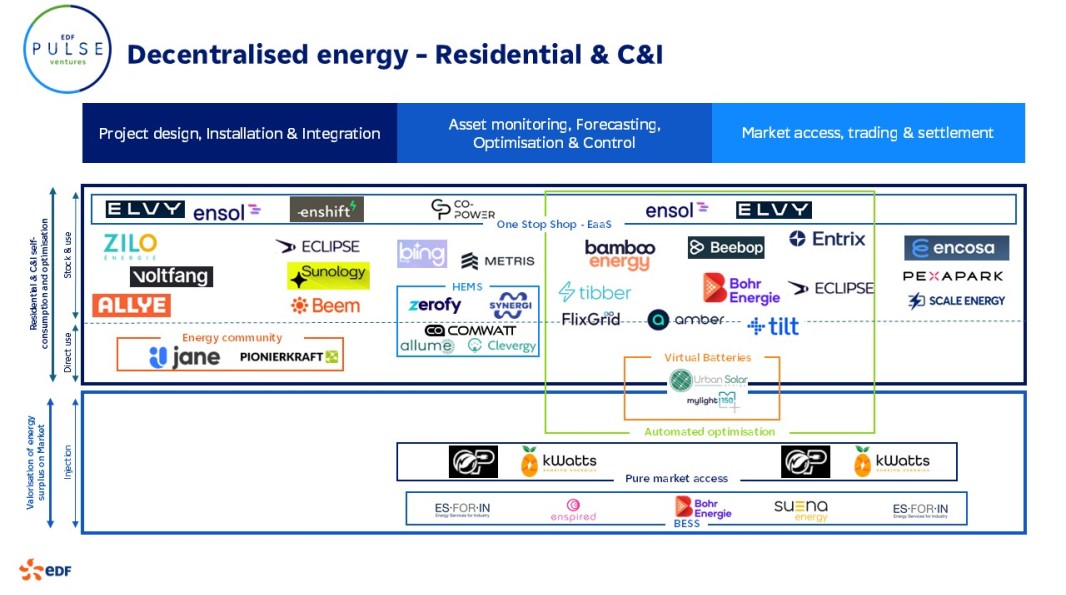
Optimisation solutions provide real-time control over all connected equipment—batteries, heat pumps, charging points and water heaters—by combining weather forecasts, electricity market prices, consumption patterns and grid signals. Their dual objective is to maximise self-consumption while generating revenue on flexibility markets. These solutions effectively bridge the gap between installed equipment and the economic value it can generate. Amber Electric, for example, has already begun rolling out such solutions at scale with European energy operators.
EDF Pulse Ventures, the Group’s corporate venture arm, has mapped the startups operating in this segment: