Predictive tools for Long Term Operation is one of the central activities of the MAI. Mathematical models not only allow us to test our understanding of fundamental processes such as stress corrosion cracking, corrosion fatigue and creep – they also enable us to capitalize on our knowledge through parameter databases. Furthermore, they are of key importance in assessing the durability of components and materials for periods beyond reasonable duration and under conditions beyond experimental reach. The Institute has one of the most powerful supercomputers owned by a non-government organization. This computer power greatly speeds up complex numerical simulations, including dislocation dynamics, molecular dynamics, ab initio modelling, Monte Carlo simulations, as well as simulation of complex 3D structures of materials. Simulations which used to take about one month of computation time can now be performed in a few hours.
The more than 40 years operating experience and plant life management expertise represented by the members of the MAI represent a unique and valuable resource for the study of materials aging mechanisms. Operational feedback data are obtained using samples of material that are made available by utilities after the replacement of specific components.

Presentation of the C3D-NDT Code
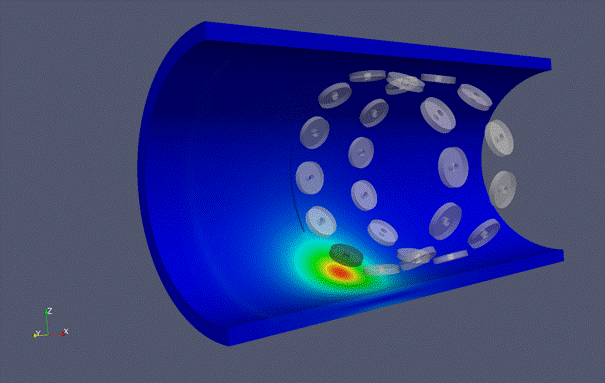
C3D-NDT is a specialized software tool dedicated to the inspection of steam generator tubes using the Eddy Current Testing (ECT) non-destructive testing method.
Developed by the ERMES Department within EDF R&D, it relies on a finite element numerical code for the three-dimensional modeling of electromagnetic fields. C3D-NDT is equipped with a user interface that allows the definition of numerous study parameters, including probe characteristics, tube types and geometries, defect configurations, influencing parameters, and calculation modes.
Industrial Context
The main applications of C3D-NDT include probe performance assessments and qualification studies, as well as investigations of increasingly complex and realistic defects, including defects combined with external influencing parameters.
C3D-NDT is designed to meet both R&D needs and engineering requirements, providing an optimized solution to support the operation and maintenance of the power generation fleet.

Presentation of Vi(CA)2T
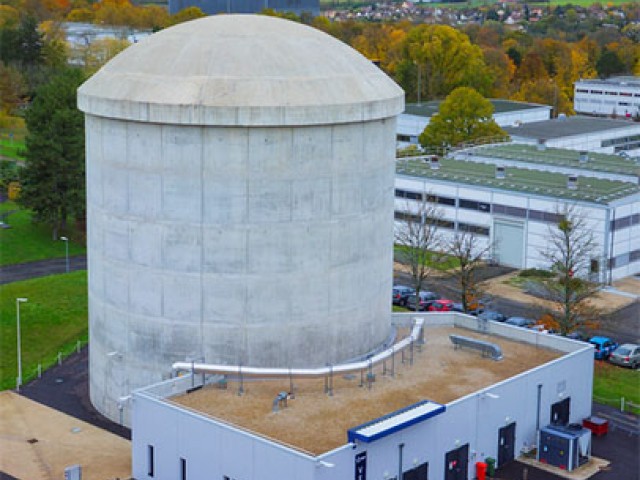
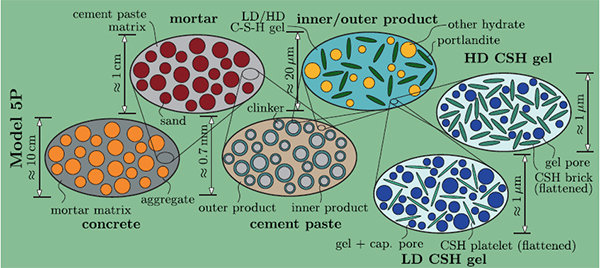
(Vi(CA)2T is a software toolbox dedicated to concrete, able to estimate properties and behaviors from the mix design details. To do so, it embeds two types of models:
- Homogenization modes : from elementary behavior of phases and from morphological models, the effective properties and behaviors are estimated (such as stiffness, basic creep compliance or dielectric permittivity).
- Cement paste hydration models: combining chemistry and kinetics, from the initial mix design information, the amounts of each phase (anhydrous phases, hydrates, water and, by extension, porosity) and the hydration physical properties (temperature,released heat) are estimated as a function of time.
Besides its industrial applications, this toolbox is also used as a pedagogical support for training sessions about properties and ageing of cementitious materials.
Industrial Context
To manage the long term operation of power plants civil engineering facilities, EDF has adopted an integrated approach. It is based on three pillars, structural analysis, inspection and material knowledge, complementing each other:
- without structural analysis, anticipating the future behavior of structures or evaluating the impact of mitigation and reparation strategies is not possible;
- without inspection, the current state of structures cannot be diagnosed;
- without material knowledge and modeling, structure computations cannot use relevant material properties and behaviors, and raw data from indirect inspection techniques cannot be properly interpreted (ex: when water content is indirectly measured through dielectric permittivity).
Vi(CA)2T contributes to this last item about material properties and behaviors.

Presentation of VIRTUAL POLYMER
VIRTUAL POLYMER is a multi-scale modeling tool designed to predict the evolution of material properties during aging and to estimate their remaining service life.
Industrial context
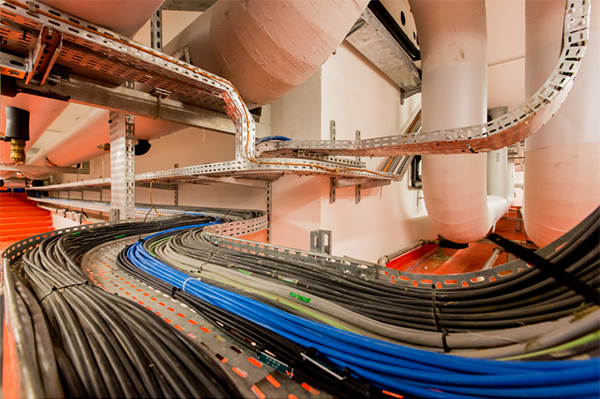
Each nuclear power plant contains approximately 15,000 km of electrical cables. This network is extremely difficult to replace because of its extensive coverage and limited accessibility. As part of the long-term operation of nuclear reactors up to 60 years and beyond, EDF R&D launched the CAIMAN project at its EDF Lab Les Renardières research center to monitor and predict the lifetime of these critical components.
Cable durability is one of the major research areas within EDF R&D. For several decades, the Polymers Team of the Chemistry and Materials for Energy Efficiency Group has been conducting studies on cable aging. During accelerated aging campaigns, material characterization is performed across multiple scales, from the molecular level to the macroscopic level, within the team's laboratory facilities. These studies aim to investigate degradation mechanisms and assess the effects of aging on the functional properties of the polymer materials used in the sheath and insulation of electrical cables.
At the same time, expert assessments are carried out on cables collected from operating power plants to establish correlations between accelerated aging and natural aging, and to provide expert evaluations regarding the durability of these sampled components.
To support engineering activities in this field, the Materials and Component Mechanics Department of EDF R&D has developed the VIRTUAL POLYMER numerical tool. Based on a multi-scale approach, this tool enables the prediction of material properties throughout the aging process and the estimation of remaining service life by comparing simulation results with predefined end-of-life criteria.
Process and the estimation of remaining service life by comparing simulation results with predefined end-of-life criteria.

Presentation of CORIOLIS
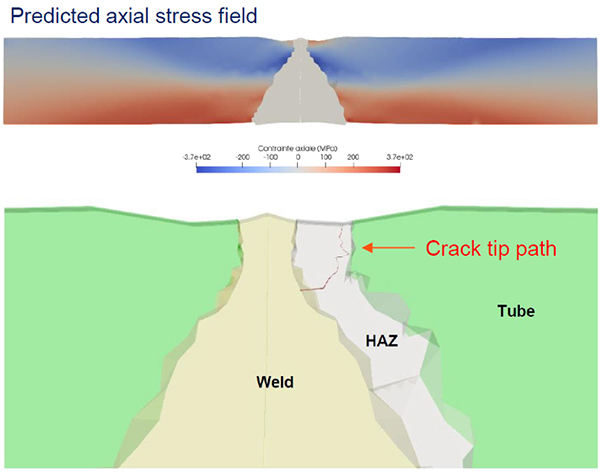
CODE_CORIOLIS has been developed by EDF R&D to predict Stress Corrosion Cracking (SCC) kinetics and location in 3D structures. The simulation is based on a fast post finite element modeling analysis chaining IGSCC initiation and crack growth models. Code_Coriolis offers new possibilities for various type of users :
- for researchers : better calibrate and validate SCC models, with a global 3D view, by-resimulating SCC lab tests
- for engineers and end-users : better predict SCC in large industrial components (modeled in 3D), as a support to examinations on retired components or for parametric studies.
Our first computations demonstrated that SCC can be simulated at the scale of a ‘large’ component thanks to a physically-based model relying on local observations (SEM, TEM) and small scale simulations (crystal plasticity). Our efforts are currently being addressed on the validation of the developed methodology, based on mockup characterizations and operational experience
Industrial Context
CODE_CORIOLIS is a digital tool developed by EDF to apply SCC models at the scale 3D components. The digital tool CODE_CORIOLIS gives as an output data the time to initiation on the whole surface of the component and the cracking path and depth in function of time: fundamental behaviours for incubation and initiation steps are integrated, coupled and chained with propagation laws in 3D-structures within seconds thanks to power of digital.