With shipping still heavily reliant on fossil fuels and European regulations becoming increasingly stringent, decarbonising the sector is emerging as a major energy challenge. At the heart of this transition, ports will need to evolve into fully fledged electricity hubs, capable of supplying power to vessels at berth while supporting the growth of electric and hybrid fleets. EDF Pulse Ventures, EDF’s corporate venture capital arm, is currently exploring this emerging market to identify the startups that will help build the port infrastructure of tomorrow.
Shipping: electrification is becoming essential
Shipping is one of the pillars of the global economy. In Europe, it accounts for nearly 85% of imports and 80% of exports by volume. Since container shipping took off in the 1960s, the globalisation of trade, the growth of emerging markets and increasingly fragmented supply chains have driven a dramatic rise in the volume of goods transported by sea, from 0.5 billion tonnes in 1960 to more than 10 billion tonnes today.
This growth has inevitably led to rising energy demand and, in turn, higher greenhouse gas and sulphur dioxide emissions from the sector. Shipping accounts for nearly 3,000 TWh of annual energy consumption worldwide and remains 99% dependent on fossil fuels, particularly heavy fuel oil, the main fuel used to propel ships.
Decarbonising shipping is therefore a major environmental challenge. There is currently no single technological solution capable of meeting every use case, and making the transition will require coordinated action from public- and private-sector stakeholders across the entire maritime value chain. Electricity, hydrogen, synthetic fuels and biofuels each address different requirements depending on vessel size and the distances travelled. Shipowners and shipping companies therefore need to make decisions today that will shape their operations for decades to come, even as some technologies have yet to reach maturity and the necessary infrastructure remains unevenly available.
Ports at the heart of shipping’s energy transition
Against this backdrop, electrification is one of the most readily available levers for decarbonisation, particularly in ports. Onshore Power Supply (OPS) can meet vessels’ energy needs while they are at berth, replacing auxiliary engines and improving local air quality for nearby communities. Electrification can also support the development of electric and hybrid vessels and, more broadly, the transition towards electrified port operations.
In Europe, this shift is no longer being driven solely by the sector’s environmental ambitions. Regulation is now accelerating the transition, requiring changes to be made in the near term.
The EU’s Alternative Fuels Infrastructure Regulation (AFIR) provides for the gradual deployment of shore-side electricity infrastructure. By 2030, major ports handling container ships, ro-pax ferries and other passenger vessels will need to provide sufficient shore-side electricity capacity to cover at least 90% of the relevant port calls. The inland ports covered by the regulation will, meanwhile, be required to provide at least one shore-side electricity installation.
At the same time, FuelEU Maritime requires a gradual reduction in the greenhouse gas intensity of the energy used on board ships. Here too, 2030 will be a key milestone: certain categories of vessels will be required to connect to and use shore-side electricity when it is available.
In France, these EU regulations apply directly and form part of a broader decarbonisation pathway, supported in particular by France’s National Low-Carbon Strategy (SNBC) and the maritime sector’s decarbonisation roadmap introduced under the Climate and Resilience Act.
The transition is therefore already under way, with the electrification of vessels’ energy use at berth representing the first step in the near term and requiring port electricity infrastructure to evolve accordingly. But in the future, port electrification will involve much more than simply deploying OPS infrastructure. Ports will need to deliver significant amounts of electrical power, in the right place and at the right time, to supply vessels during port calls, support the emergence of new propulsion systems and progressively electrify port operations. In other words, as shipping decarbonises, ports will evolve into genuine energy hubs capable of supplying electricity for a wide range of uses.
Supporting this transition against a backdrop of grid constraints and fluctuating energy markets will make the optimisation and flexibility of port energy infrastructure a key priority. Power requirements can vary significantly depending on the use case and the frequency and duration of port calls. At the same time, fluctuations in electricity prices and the ability to monetise demand response can provide valuable opportunities for cost optimisation, provided that flexible and controllable solutions are in place.

EDF Group expertise at the heart of ports’ energy transition
For EDF, exploring the electrification of shipping is a natural extension of its expertise as an energy company and a partner in the decarbonisation of energy use. Since 2024, EDF has also been involved in MEET2050, the French institute dedicated to decarbonising maritime transport.
More importantly, the Group brings together complementary expertise spanning the various dimensions of port electrification, including electrical engineering, energy storage, flexibility, energy management and electric propulsion. This ecosystem provides a particularly strong foundation for identifying new technologies and creating future synergies with startups.
This is precisely the role of EDF Pulse Ventures, EDF Group’s corporate venture capital arm: to identify and invest in innovative solutions developed outside the Group, create synergies with EDF’s businesses and accelerate electrification.
Seven innovation areas on EDF Pulse Ventures’ radar
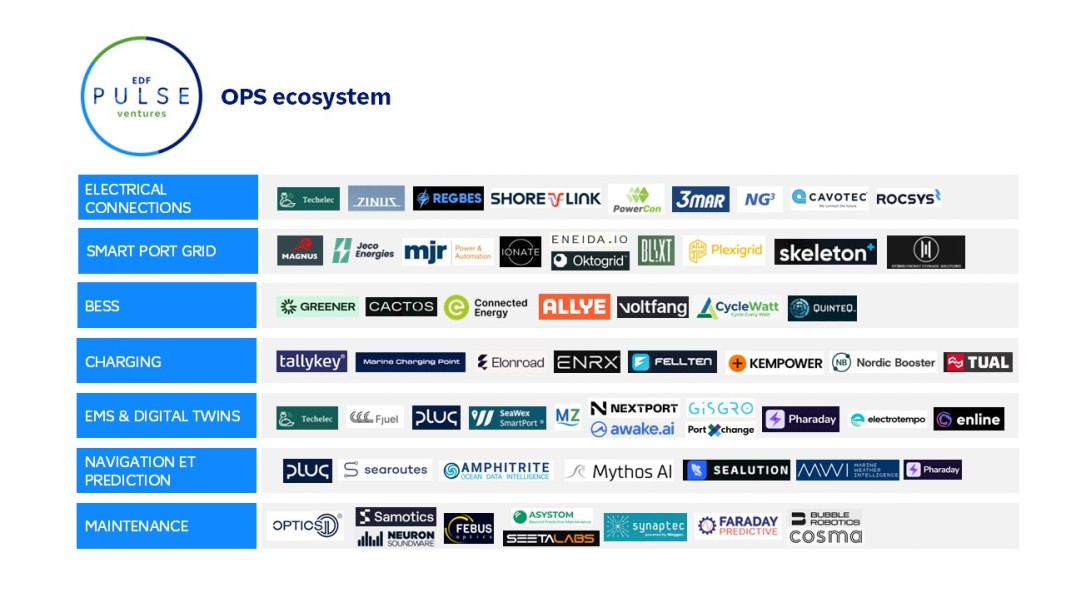
EDF Pulse Ventures’ sector analysis has identified seven priority investment areas with the potential to support port electrification.
- Shore-to-ship connection systems are a key component of OPS infrastructure and represent a first strategic building block. These connections need to address challenges around compatibility, automation and power capacity, with requirements ranging from approximately 200 kW to more than 15 MW depending on the type of vessel.
- EMS and digital twins are another key area. They can be used to model and forecast how a port’s electricity demand will evolve, helping to anticipate future requirements and optimise the design of its electrical infrastructure while taking into account port traffic, vessel types, grid constraints and other factors.
- Smart port grids will need to accommodate increasingly high power demands while coordinating a diverse range of electrical loads, including ships, lorries, port equipment and light vehicles, alongside energy storage and generation assets. Adaptable monitoring and energy management systems will therefore become essential to maintaining an optimal balance across these networks.
- Charging technologies represent another key market. Beyond OPS, the growth of electric ferries, shuttle vessels and service vessels will create demand for increasingly high-power, fast-charging solutions, with automated connection and interoperability emerging as major challenges.
- Battery energy storage systems (BESS), alongside electrostatic energy storage technologies, could complement this infrastructure by managing peak power demand and providing greater flexibility to port electricity systems.
- Navigation and predictive solutions will help anticipate vessel arrival times, the duration of port calls and associated energy requirements, enabling more efficient use of electrical infrastructure.
- Finally, as ports evolve into fully fledged electricity hubs, monitoring, inspection and preventive maintenance technologies will be essential to ensuring the availability and resilience of this new critical electrical infrastructure.
EDF Pulse Ventures has mapped out a non-exhaustive selection of startups operating across each of these areas: