
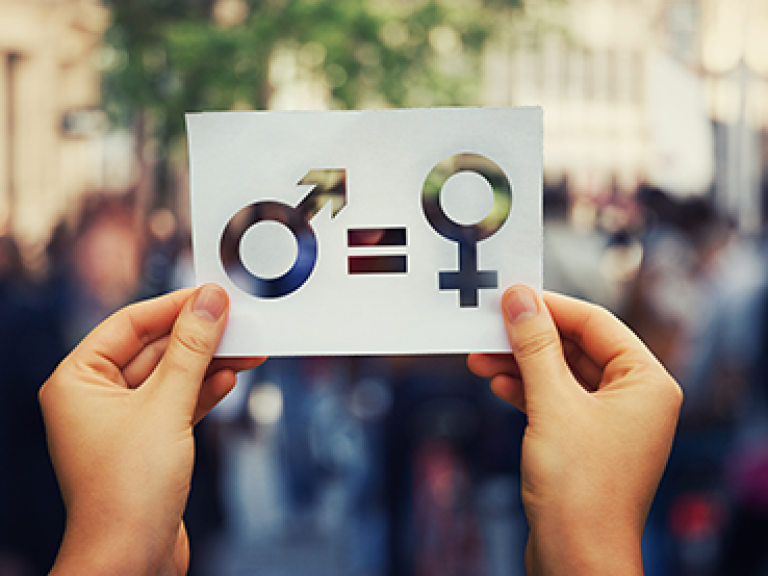
EDF SA has achieved the maximum score of 100 points for the first time, confirming the strength of its approach to gender diversity and professional equality between women and men. Furthermore, for seven consecutive years, the company has maintained a level of excellence with an index never falling below 90 points.
Implemented after the introduction of the law on "Freedom to Choose One's Professional Future" dated 5 Septemper 2018, this indicator allows companies in particular to measure the pay gaps between women and men, and to showcase the progress that they are making.
What can we learn from this score?
EDF reaches the maximum performance level
With a rating of 100/100, the company is scoring the maximum number of achievable points for 5 out of the 5 indicators that make up the index[1].
[1] EDF SA's detailed 2025 results and comments are available under the heading "What is the gender equality index? " (see below)
| Indicator value | Points obtained | Maximum indicator points | ||
|---|---|---|---|---|
| 1- The gender pay gap (as a %) | 0 | 40 | 40 | |
| 2 - Gaps in the distribution of individual pay rises (as % points) | 1,6% | 20 | 20 | |
| 3 - Gaps in the distribution of promotions (as % points) | 1% | 15 | 15 | |
| 4- The percentage of employees who have benefited from a pay increase on return from maternity leave (%) | 100 | 15 | 15 | |
| 5 - The number of employees of the under-represented gender among the company's 10 highest-earners | 4 | 10 | 10 | |
| INDEX (out of 100 points) | 100 | 100 | ||
This result, an improvement compared to 2024, confirms the company's very positive momentum in gender diversity and professional equality, with an index consistently above or equal to 90 points for the past seven years. It is also the result of a long-term commitment marked by several company agreements signed with social partners since 2004.
Over the last decade in particular, the company has strengthened its management and monitoring mechanisms to guarantee equal opportunities for women and men within the company.
While equal pay for women and men is one of the cornerstones of professional equality, other equally important issues are addressed by EDF: equal opportunities in career paths, gender diversity in professions, particularly in technical roles (across all hierarchical levels), and work-life balance.
EDF is also working on changing attitudes by fighting against sexist behavior and more generally all forms of discrimination and violence, for which the company affirms a zero tolerance policy.
The EDF Group’s ambition for gender inclusiveness
EDF has set itself a challenging ambition for gender inclusiveness
In 2019, for the first time, EDF’s Executive Committee defined a Group-wide gender inclusiveness ambition, with a view to setting a benchmark for the industry. This ambition is focused on three aspects :
- Breaking the glass ceiling, up to the highest levels of responsibility and governance.
- Encouraging entry into technical professions
- Guaranteeing non-sexist communication , that promotes balanced gender representation.
In 2021, following the encouraging results achieved in the first two years, the Executive Committee took the decision to further reinforce this commitment, with the targets:
- 33% of women by 2026
- 36 to 40% of women by 2030
at all levels of the company (workforce, managers, and governing bodies).
Representation of women in the company’s governing bodies
Law No. 2021-1774, known as the Rixain law, adopted on 24 December 2021 and published in the Official Journal on 26 December 2021, to speed up economic and professional equality, set out the gradual introduction by 2029 of a quota for a balanced representation between women and men in management positions and governing bodies of companies with 1,000 or more employees (Article 14 of the law).
Within this framework, it also establishes an obligation for companies to publish yearly, from 1 March 2022, the inequalities in representation between women and men in the company’s management teams and governing bodies.
At the end of 2025, the figures for EDF SA were as follows :
- 30% of women in its overall workforce
- 31,2% of women in management roles
- 33,9% of women in its management committees[1]
- 29% of women among its senior staff
- 35,7% of women in its governing body[2]
As a reminder, the proportion of women managers and that of women members of governing bodies has improved by over 50% over the last decade.
Other key numbers
- Women now represent 26,5% of the EDF Group’s workforce (30% for EDF SA), which places it in the middle to upper category of major French industrial groups.
- Nearly 45% of women working for EDF SA are now in technical roles (they represent 17% of the company’s technical workforce).
- 57% of women recruited by EDF SA in 202( were taken on in technical and IT roles.
What is the male/female equality index?
The law on "Freedom to Choose One's Professional Future" puts forward new measures to support gender equality. How can this equality be measured? By using a male/female equality index, which companies with over 50 employees must calculate and publish every year. Companies now have an obligation based on results achieved rather than means used.
The equality index is calculated out of a possible 100 points, using 5 performance indicators that are weighted according to the following criteria (decree of 8 January 2019).
By law, companies have 3 years from the publication of their first index result to reach a score of 75 points out of 100. Failing that, they must introduce corrective measures, and in particular close the wave gap for women.
For the year 2025, EDF has published a score of 100 points, an improvement compared to the previous year. Specifically, the results obtained on the 5 indicators are as follows:
- On indicator #1, relating to the elimination of average pay gaps (base salary + variable pay) between women and men in comparable positions and ages, EDF achieved 40 out of a possible 40 points. For this calculation, the company used the 4 age brackets stipulated by law and relied on the concept of employee categories (operational, supervisory, managerial), which remain key levels in analyses conducted on gender equality within the company (see the comparative situation reports since 2004).
-
On indicator #2, which aims to ensure that women and men have equal opportunities for salary increases (non-recurring salary increases excluding promotions), EDF scores 20 out of a possible 20 points, given that the average difference, weighted by the number of employees in each category, remains within the relevance threshold of +/- 2 points defined by the decree. Analyzing this performance by category at the end of 2025, we observe a fairly balanced distribution in the operational and managerial categories, and a slightly more significant disparity against women in the supervisory category (women representing 11.6% of the total workforce), but an improvement compared to 2024 (-0.5 points). On this indicator, as on the following three, it remains crucial to have implemented management tools and ongoing monitoring to ensure compliance with gender parity in the distribution of salary increases within the company.
- On indicator #3, which is the counterpart to the second but focuses on promotions (career progression), EDF again scores 15 out of a possible 15 points. By the end of 2025, all the discrepancies observed by job category remain within the relevance threshold of +/-2 points defined by the decree. The analysis by job category confirms relatively stable results that can vary from year to year, either favoring or disfavoring women. In 2025, for example, the majority of the unfavorable gap for women was concentrated in the supervisory job category (-0.5 points), but also in the operational job category (-6.7 points), while the distribution stabilized positively for women in the managerial job category (+0.6 points).
- On indicator #4 relating to neutrality, in terms of main remuneration, maternity or adoption leave, EDF was able to award itself 15 points out of the 15 possible by the end of 2025. There is indeed a system of systematic examination of the salary situations of employees who have had a child in the past year (548 situations analyzed for 2025), which notably allows the allocation of NR on national quota to prevent any unjustified discrepancies. This process is now centrally managed within the Group HR department to ensure comprehensive processing, a parallel system for non-permanent employees, and appropriate adjustments for specific situations (e.g., consecutive full-time parental leave, etc.).
- Finally, regarding indicator #5, which relates to the number of women among the company's 10 highest earners, EDF has achieved a perfect score of 10 out of 10 this year for the first time (with 4 women among the top 10, representing an increase of one woman compared to 2024). This commitment to better representation of women in leadership positions and among the company's executives is now being addressed at the highest levels of the organization.
[1] CODIR
[2] COMEX
Focus on the Insular Energy Systems Division (PEI)
| Calculable indicator | Value of the indicator | 2022 | Max | |
|---|---|---|---|---|
| Indicator | 1 | 3,4% | 36 | 40 |
| Indicator | 1 | 9,8% | 20[1] | 20 |
| Indicator | 1 | 3% | 10 | 15 |
| Indicator | 1 | 100% | 15 | 15 |
| Indicator | 1 | 5 | 10 | 10 |
| TOTAL | 5 | 91 | 100 | |
-
-
[1] This indicator obtains the maximum score, as it focuses on the workforce with the lowest wages in respect to the results for indicator 1.
In 2022, EDF PEI improved its performance with a "male/female equality index" score of 91 points (compared to 83 points in 2021 and 84 points in 2020).
For EDF PEI, this demonstrates that since the introduction of the index, and today still, the status of women is improving, contrary to what is often seen in other companies. The number of women among the 10 highest earners is high, as is the proportion of women in the Management Committee.
+G9The company is pursuing its actions for further progress: a pay package has been determined to reduce wage gaps; special attention will be given to the awarding of promotions and individual wave increases; work will continue to raise awareness of the need to fight against harassment, sexism and discrimination, in line with the EDF Group's existing guidelines and systems.
Furthermore, the two objectives for improvement that EDF PEI set itself to meet the obligation of companies with a score below 85 points (83 points in 2021) have now been reached (indicator 1: reduce wage gaps between women and men; indicator 2: equalise the wage increase rate between women and men in the socioprofessional category supervision).